EMS Training for Athletes: A Smarter Way to Build Running Strength
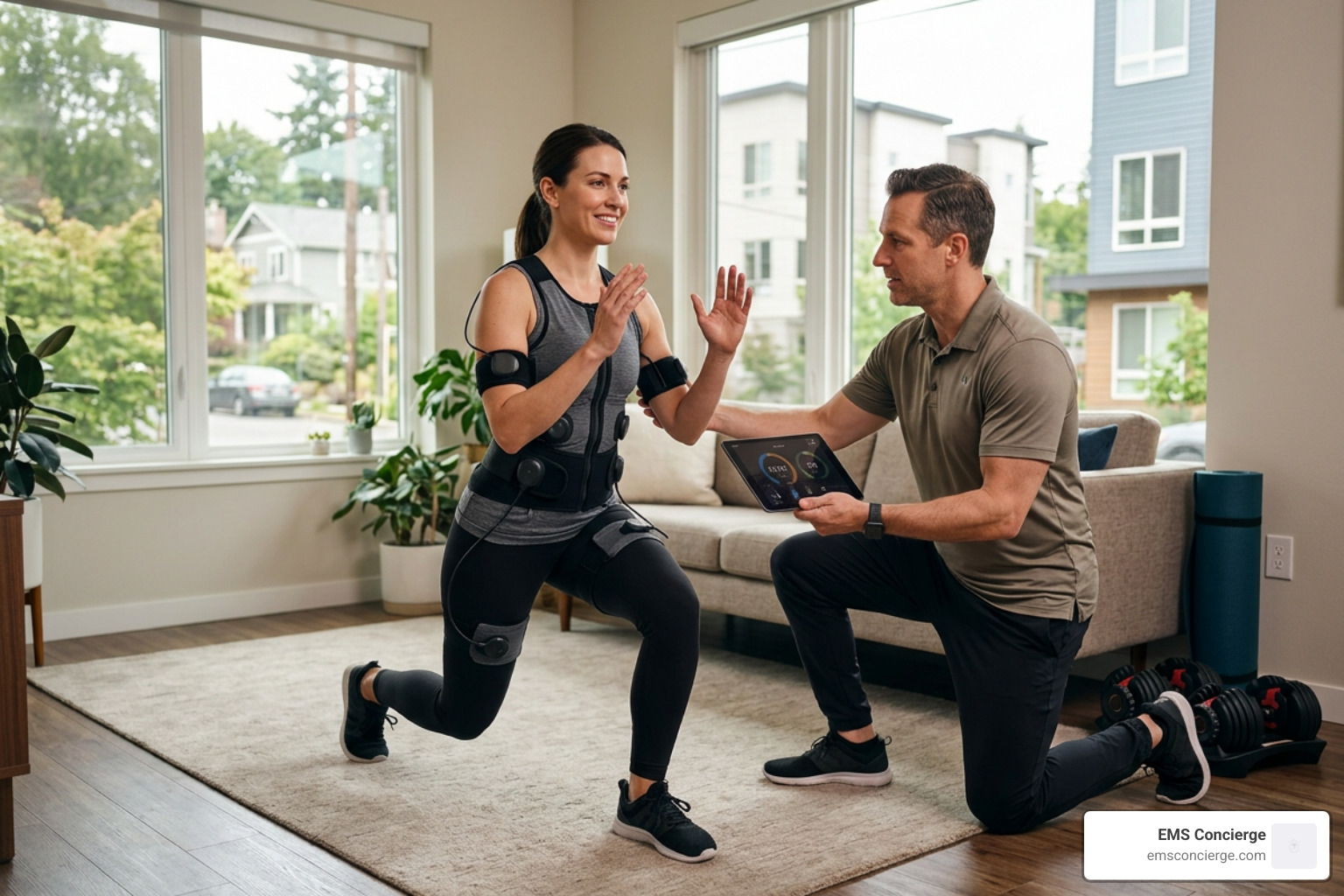
EMS training for athletes can support running performance when it is used as a supplement to running and strength work, not a replacement. Electrical impulses trigger muscle contractions while you move through controlled exercises, helping you train major muscle groups with little impact and no heavy external loading. For runners, this means a low-impact way to strengthen the glutes, hamstrings, core, and hips without adding more pounding to already fatigued legs.
For busy runners, the practical approach is simple:
- Use EMS for low-impact strength work that targets the glutes, hamstrings, core, and hips.
- Keep long runs, speed sessions, and sport-specific drills as the foundation of training.
- Schedule hard EMS sessions away from key races or intense workouts, and use lower-intensity settings for recovery when appropriate.
- Start under qualified supervision, progress intensity gradually, and prioritize hydration and recovery.
The appeal is not a shortcut around training. It is an efficient way to add a strength stimulus while limiting joint stress and managing the fatigue that can come with heavy lifting. For runners, stronger posterior-chain muscles and better activation may support force production during push-off, posture late in a race, and more resilient stride mechanics. This is especially valuable during high-mileage blocks when heavy lifting sessions can leave the legs feeling heavy and unresponsive.
EMS is also not risk-free. Excessive intensity, poor progression, or training despite a medical contraindication can cause harm. The best programs fit EMS into a broader plan built around running volume, sleep, nutrition, and targeted strength training. When integrated thoughtfully, EMS becomes a practical tool for maintaining strength, improving activation, and supporting recovery without compromising the quality of your key running workouts.
The Physiological Mechanics of EMS Training for Athletes
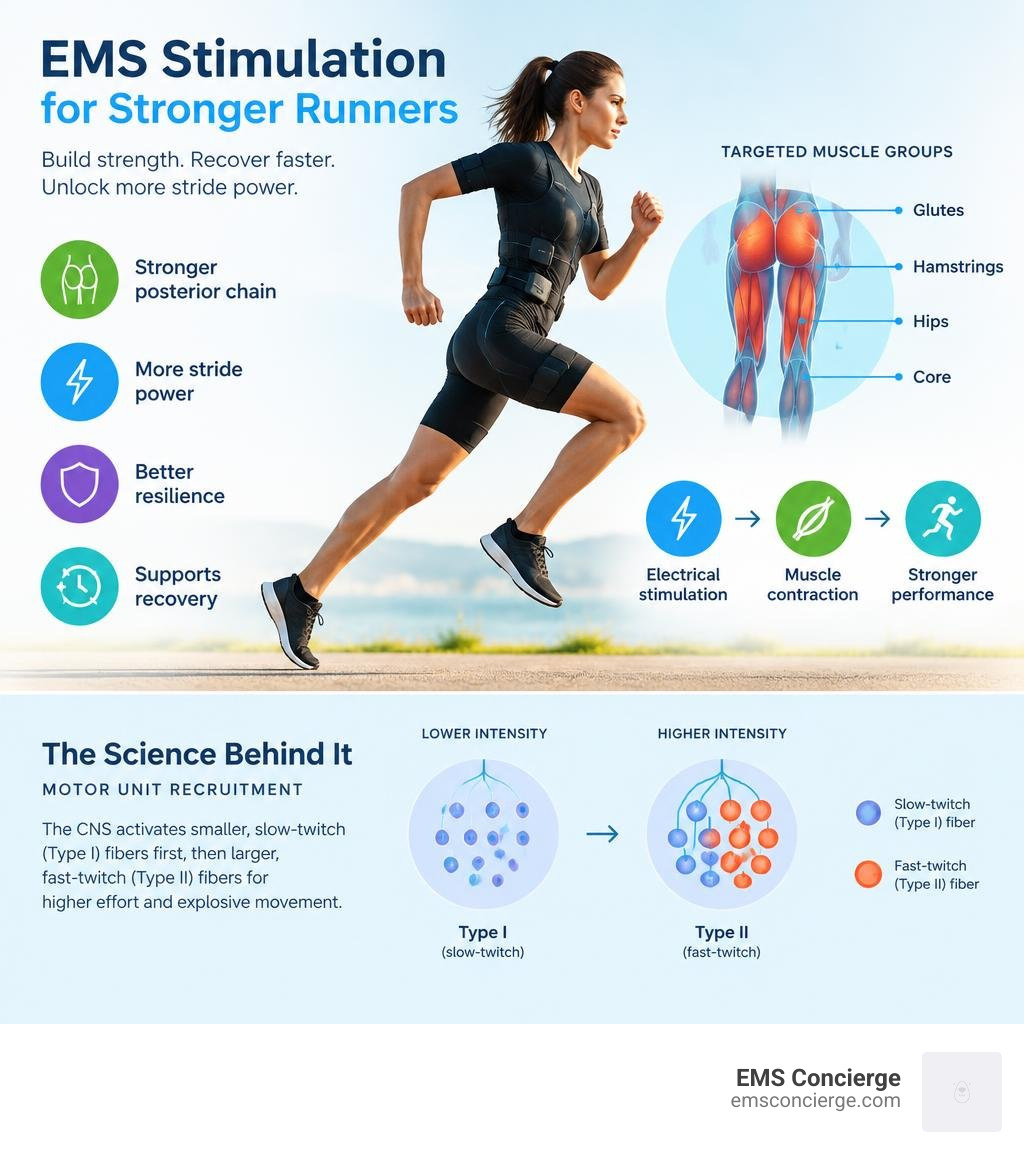
To understand how electrical muscle stimulation optimizes athletic performance, we must examine motor unit recruitment. During voluntary contractions, the body adheres to Henneman’s size principle: the central nervous system (CNS) activates smaller, slow-twitch (Type I) motor units first, reserving larger, fast-twitch (Type II) fibers for maximum loads or rapid explosive movements.
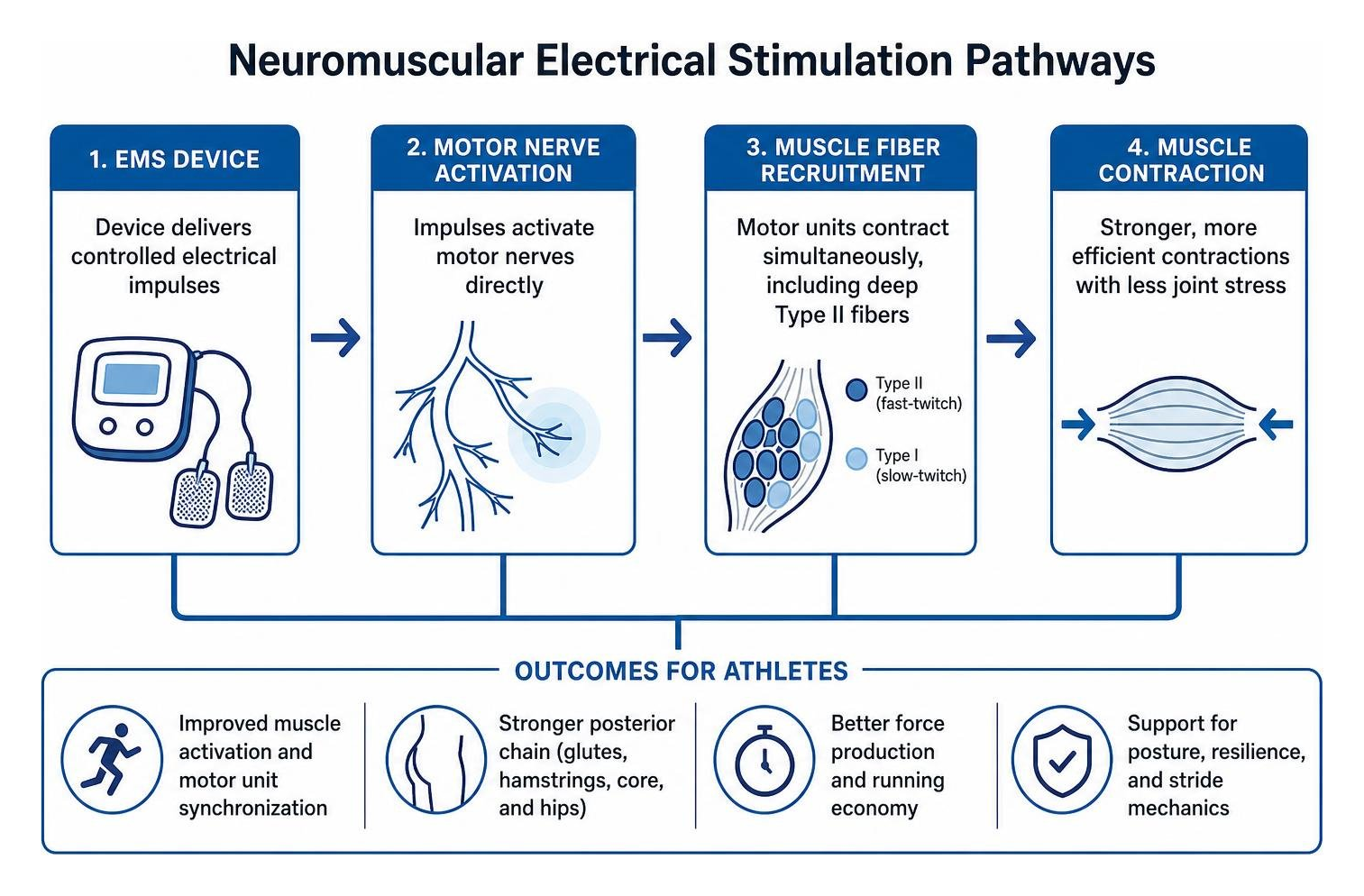
Whole-body EMS alters this dynamic. By sending controlled electrical impulses directly to motor nerves, it bypasses standard recruitment order, activating deep Type II muscle fibers simultaneously with oxidative fibers at lower physical strain. If you are curious about understanding how electrical impulses drive deep muscle recruitment, the process fundamentally taps into neuromuscular pathways that are notoriously hard to isolate through standard bodyweight exercises alone. Reviewing the fundamental concepts of electro-muscle stimulation reveals why this modality provides such targeted stimulus for endurance and power athletes alike.
Neuromuscular Adaptations and EMS Training for Athletes
For endurance runners, neuromuscular efficiency translates directly to running economy: the volume of oxygen required to maintain a given pace. When your glutes, hamstrings, and deep postural stabilizers fire synchronously, energy leaks across the kinetic chain decrease.
Integrating targeted protocols for high-performance athletes enhances the rate of force development (RFD). This allows the foot to push off the ground with greater force in fewer milliseconds. Research confirms that electrical stimulation protocols increase motor unit synchronization, enabling runners to maintain hip extension and upright posture even under severe metabolic fatigue.
Low CNS Fatigue vs. Heavy Resistance Lifting
Traditional strength work—such as heavy squats, deadlifts, and lunges—places substantial axial load on the spine and taxes the central nervous system. In the middle of high-mileage blocks, heavy lifting can accumulate systemic fatigue, increasing injury risk and deadening leg turnover during key track intervals.
When comparing electrical stimulation against standard resistance lifting, EMS delivers intense muscular tension without placing mechanical shear forces on joints or creating severe central exhaustion.
| Training Variable | Traditional Heavy Resistance Training | Whole-Body EMS Training |
|---|---|---|
| Primary Fiber Recruitment | Sequential (Type I to Type II via load) | Synchronous / Non-selective (Early Type II) |
| Axial Spinal Loading | High (barbells, heavy loads) | None (bodyweight or light isometric movement) |
| Joint & Tendon Stress | Moderate to High | Minimal |
| Central Nervous System Fatigue | Significant | Low to Moderate |
| Session Time Commitment | 45–75 minutes | ~20 minutes |
| Primary In-Season Application | Max strength building (off-season) | Strength maintenance & neural activation |
Building Stride Power and Posterior Chain Strength Without Impact
Running is fundamentally a series of continuous, single-leg plyometric hops. The primary engine driving forward propulsion is the posterior chain: the gluteus maximus, hamstrings, and calves. Unfortunately, distance running alone does not sufficiently stimulate maximum strength adaptations in these muscle groups. Runners who neglect posterior chain strength often develop inefficient stride mechanics, reduced push-off power, and a higher risk of overuse injuries.

By deploying smart strength progression protocols, athletes can specifically target the glute-ham tie-in during isometric holds or active functional movements. This deep recruitment improves the propulsion phase of gait, shortens ground contact time, and increases stride power—all without adding pounding miles onto tired feet. The result is a more economical stride that preserves energy for the later stages of a race.
Correcting Muscle Imbalances and Aerobic Durability
Many endurance runners suffer from quad dominance and underactive glute stabilizers, leading to anterior pelvic tilt and knee pain. These imbalances often develop gradually over months of repetitive forward motion, and they can be difficult to correct through running alone. Whole-body EMS suits allow independent channel adjustment, letting us deliver higher pulse intensities to dormant glutes or stabilizing adductors while keeping overactive quads at lower levels. This targeted approach helps restore balance across the hip complex and reduces the strain placed on the knees and lower back.
Pairing balanced muscular recruitment with dedicated cardiovascular and stamina enhancement programs strengthens pelvic stability, helping runners maintain clean, efficient biomechanics throughout the final miles of a race. When the hips stay level and the pelvis remains stable, energy is transferred more effectively through the kinetic chain, reducing wasted motion and preserving leg speed as fatigue accumulates.
Accelerating In-Season Recovery and Training Support
Recovery is the true limiter of athletic progression. Between hard interval days and weekend long runs, metabolic byproducts accumulate, muscles tighten, and delayed-onset muscle soreness (DOMS) sets in. Without adequate recovery, the quality of subsequent training sessions declines, and the risk of overtraining increases.
Low-frequency recovery stimulation delivers gentle, rhythmic muscle twitches that act as a mechanical pump for the venous and lymphatic systems. This accelerates metabolic clearance, increases localized blood flow, and relaxes hypertonic tissue without raising resting heart rate. For runners, this means less residual soreness and a faster return to quality training. Implementing evidence-based athletic recovery techniques alongside targeted recovery stimulation programs gives competitive runners an effective way to bounce back between intense sessions.

Joint-Friendly Prehab and Recovery Strategies
Overuse injuries like patellar tendinopathy, IT band syndrome, and plantar fasciitis stem from repetitive load on joints with underlying muscle imbalances. Because EMS isolates muscle tissue without joint stress, it serves as an exceptional prehab tool for runners who need to build strength around vulnerable areas without adding more impact.
Athletes can build strength around vulnerable joints using low-impact strength and joint-friendly training. Extensive medical studies—including clinical evidence on neuromuscular activation and recovery—demonstrate that targeted electrical stimulation safely preserves muscle mass and neuromuscular function when high-impact loading must be restricted. This makes EMS a valuable option for runners returning from injury or managing chronic overuse conditions.
Periodization Strategies and Safe Implementation
To get the most out of EMS, it must be integrated systematically into your training schedule rather than applied randomly. A well-structured EMS program accounts for your running volume, intensity, and recovery needs, ensuring that each session supports rather than interferes with your primary training goals.
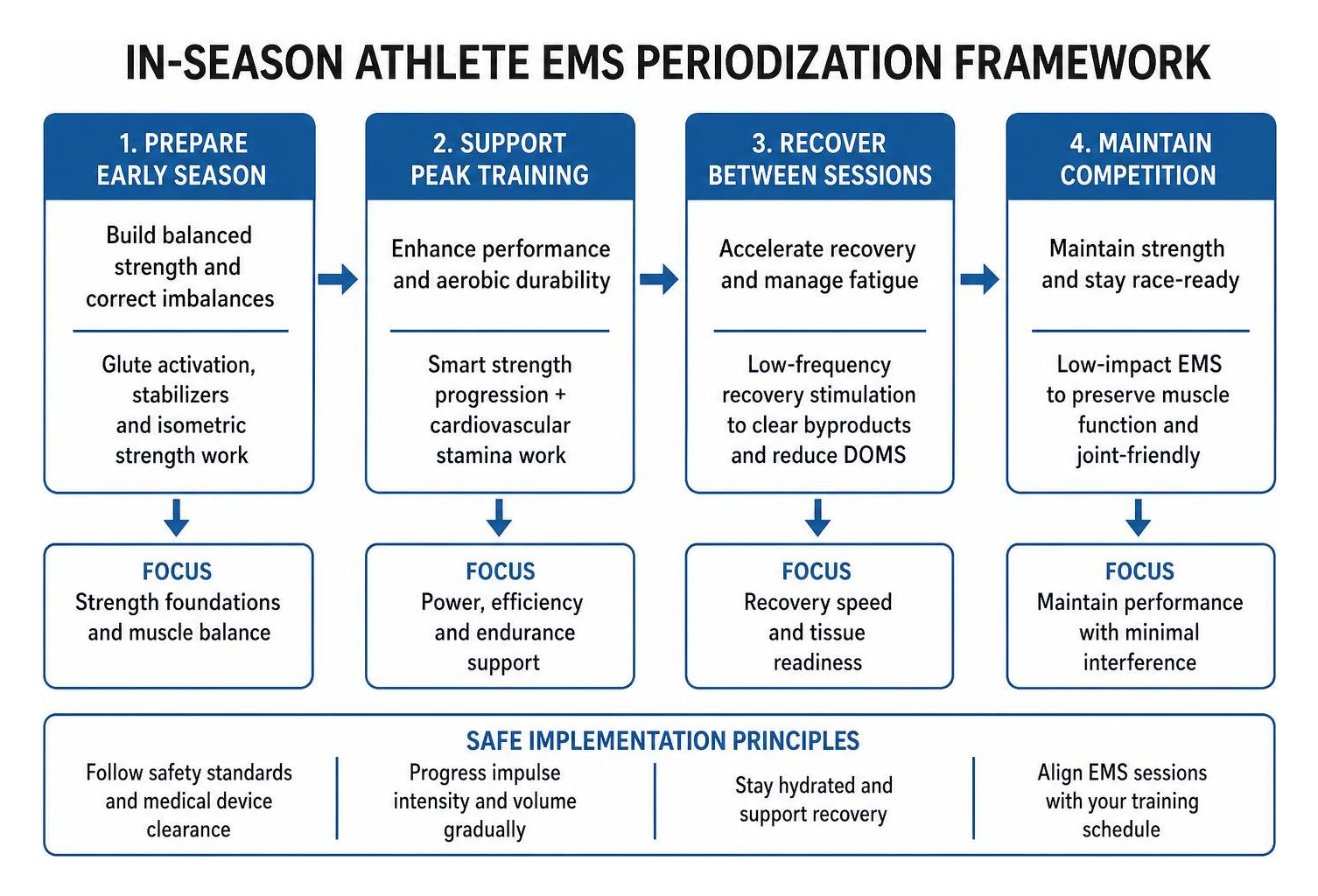
Safety must remain paramount. Ensuring professional equipment adheres to strict safety standards and medical device clearance protects against improper impulse delivery or excessive strain. Furthermore, because electrical stimulation produces high muscular tension with minimal joint strain, athletes can inadvertently overwork muscles if impulse intensity is ramped up too quickly. Proper hydration and gradual volume increases prevent excessive muscle breakdown and protect kidney function. Utilizing structured full-body conditioning workflows ensures training volume is always calibrated to your athletic calendar.
How Coaches Structure EMS Training for Athletes In-Season
During competitive phases, our certified trainers follow a clear timeline to keep athletes sharp:
- 48 Hours Pre-Competition (Neural Priming): A brief, moderate-intensity strength preset activates motor units and increases muscle tone without causing muscular damage or glycogen depletion.
- Race / Match Day: Focus entirely on competition execution.
- 24 Hours Post-Competition (Metabolic Flush): A 15- to 20-minute low-frequency recovery setting promotes blood circulation, clears cellular debris, and relieves tightness.
Curious about how this looks in practice? Take a closer look at what happens during a professional EMS session to see how exercises are paired with electrical stimulation.
Frequently Asked Questions About EMS for Runners
Can EMS replace weekly speed workouts or long runs?
No. EMS cannot simulate the cardiovascular mechanics, foot-strike conditioning, or mental endurance required for road or trail running. It is a supplemental strength and recovery tool designed to build power and resilience alongside your regular running schedule.
Are there risks or contraindications for competitive runners?
Yes. Whole-body EMS is contraindicated for individuals with cardiac pacemakers, active cardiovascular conditions, seizure disorders, or pregnancy. Certified trainers ensure impulse intensity stays within safe, productive thresholds to avoid unnecessary muscle damage.
How soon before a competition should athletes complete an EMS session?
High-intensity strength workouts should be completed at least 48 to 72 hours before a major race to allow full neuromuscular recovery. Gentle, low-frequency recovery or flush sessions can safely be used up to 24 hours before competition.
Conclusion
Maximizing running efficiency requires balancing intense training with effective muscular development and restorative recovery. By recruiting high-threshold motor units without joint stress or CNS exhaustion, electro-muscle stimulation helps runners build stride power, correct asymmetries, and recover faster between sessions. When integrated into a well-structured training plan, EMS becomes a practical tool for improving running economy, reducing injury risk, and supporting long-term athletic development.
Whether you are training across Southern California—from Santa Monica and Beverly Hills to Newport Beach and Pasadena—or training at altitude in Aspen, our certified mobile specialists bring professional-grade Miha Bodytec technology directly to your door. Ready to increase your durability and stride power? You can boost running performance and endurance with an EMS cardio program tailored directly to your athletic goals.