Realistic EMS Training Before and After Results
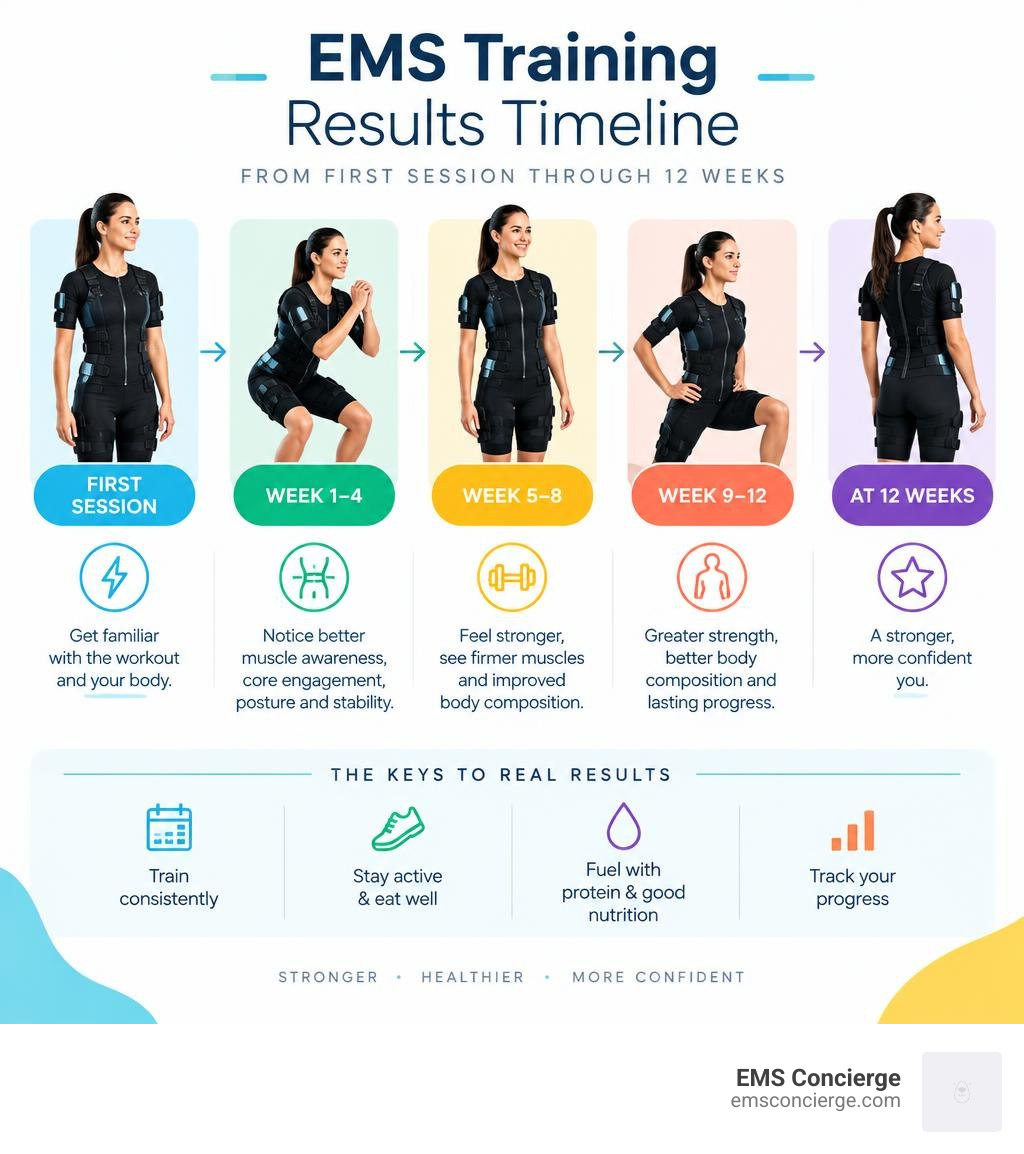
EMS training before and after results are usually felt before they are seen. In the first month, most people notice better muscle awareness, core engagement, posture, and stability after about 4 to 8 sessions. More visible changes - such as firmer muscles, improved strength, and better body composition - commonly take 8 to 12 weeks of consistent training. According to the National Academy of Sports Medicine, neuromuscular adaptations typically precede visible muscle growth in resistance training. This principle is especially apparent with EMS.
For busy professionals, the useful expectation is simple:
- Train consistently, usually once or twice weekly with enough recovery.
- Pair EMS with daily walking or other movement, adequate protein, and nutrition that fits your goal.
- Track strength, measurements, posture, energy, and how daily tasks feel - not only scale weight.
Whole-body EMS uses controlled electrical impulses alongside active movement to recruit large muscle groups with low joint impact. Research supports improvements in strength and body composition, but it is not a shortcut around recovery, food choices, or regular activity. The best results come from a progressive, supervised plan built around your current fitness, schedule, and goals.
Quick ems training before and after terms:
What to Expect from EMS Training Before and After 12 Weeks
Setting the right expectations is essential for any fitness journey. When evaluating your progress with whole-body electro-muscle stimulation (WB-EMS), understanding the physiological adaptation timeline helps you appreciate the internal shifts happening long before you notice physical changes in the mirror.
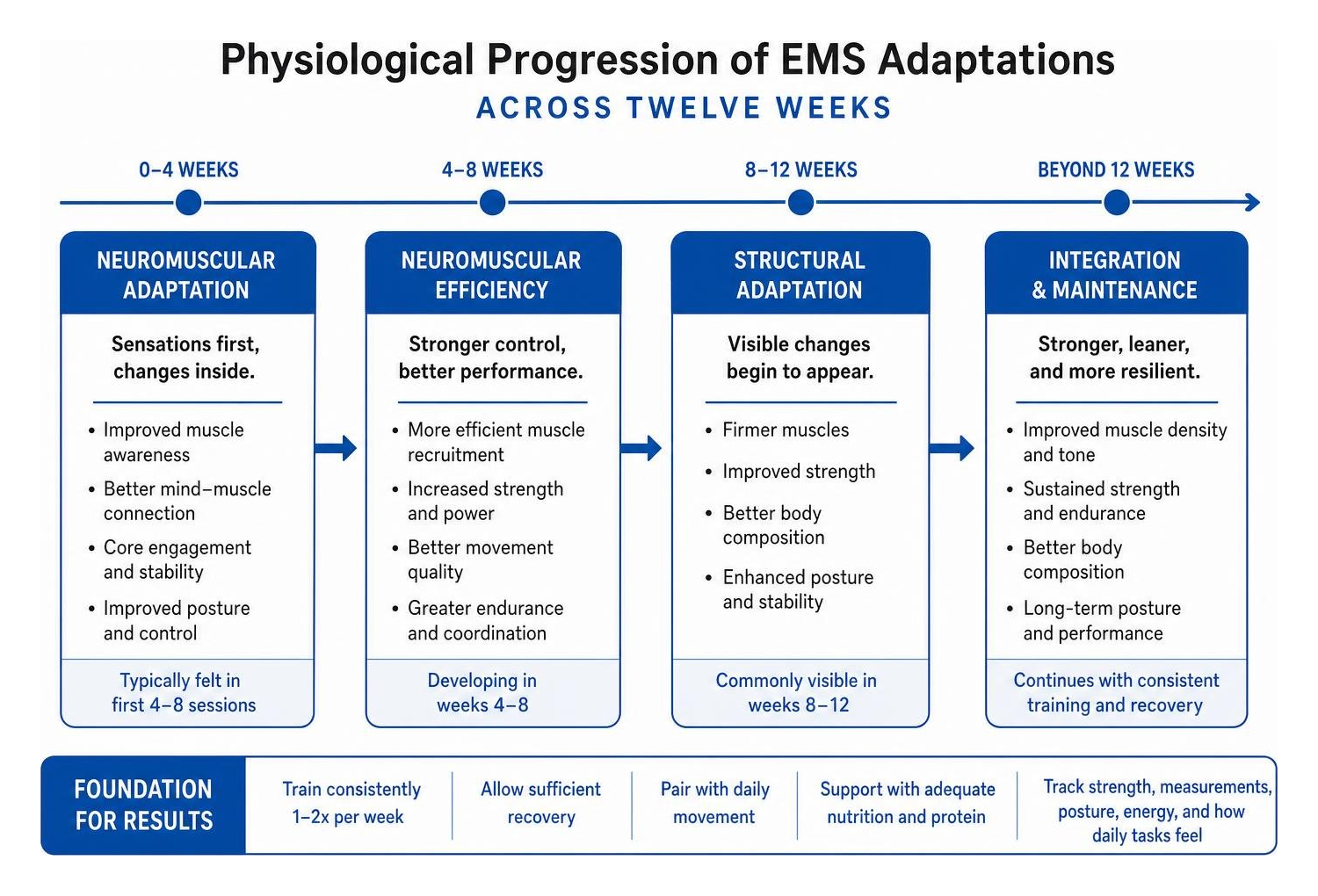
EMS delivers low- to mid-frequency electrical impulses directly to motor nerves, prompting involuntary muscle contractions that work synchronously with your voluntary movements. Because this engages up to 90% of muscle fibers simultaneously—including deep stabilizing layers that traditional weightlifting often misses—the initial adaptations are primarily neurological. Over a 12-week horizon, these early neuromuscular patterns evolve into tangible changes in muscle density, posture, and body composition.
Documenting EMS Training Before and After: The First 30 Days
During the first 4 weeks (typically covering your first 4 to 8 sessions), your body undergoes significant neuromuscular recalibration. If you are exploring how whole-body EMS technology works, you will quickly discover that the initial sensations are sensory and functional rather than strictly visual.
- Sensory Awareness & Mind-Muscle Connection: Many people spend years performing squats or planks without fully engaging their glutes or transverse abdominis. The targeted impulse forces you to feel exactly where your muscles are firing, creating an immediate boost in bodily awareness.
- Initial Firmness & Muscle Tone: Within 4 to 6 sessions, muscles feel firmer to the touch at rest. This is due to enhanced baseline muscle tone (resting tension) and increased fluid and nutrient delivery to stimulated fibers.
- Posture Correction: Because EMS activates the postural chain—including the rhomboids, latissimus dorsi, and spinal erectors—without requiring heavy spinal loading, clients frequently report sitting taller and experiencing less midday neck or shoulder fatigue within their first two weeks.
- Daily Functional Ease: Lifting groceries, carrying children, or walking up stairs begins to feel noticeably lighter due to rapid gains in motor unit synchronization.
While the scale may not shift dramatically in the first month, the foundation for long-term metabolic and structural adaptation is firmly established during these first 30 days.
Long-Term EMS Training Before and After Changes at 8 to 12 Weeks
Between weeks 8 and 12, the internal neurological gains translate into visible physical transformations. By this stage, the body has adapted to the systemic stimulus, allowing for progressive increases in impulse intensity and more dynamic functional movement patterns.
Scientific research demonstrates that structured, multi-week EMS protocols produce statistically significant enhancements in lean mass and functional capacity. In an 8-week study examining frequency-specific EMS combined with training, participants achieved measurable increases in muscle strength and reductions in body fat percentage (Lee et al., 2023).
Key transformations typically documented by week 12 include:
- Visible Muscle Definition: Targeted stimulation promotes hypertrophy (muscle growth) in both primary movers and supporting stabilizers, creating defined lines in the core, arms, thighs, and glutes.
- Body Recomposition: When paired with adequate protein intake and balanced energy expenditure, EMS helps shift your ratio of lean muscle to adipose tissue. You may find that your clothes fit significantly better even if your scale weight remains relatively stable.
- Metabolic Rate Support: Muscle tissue is metabolically active. By building and preserving lean mass, your resting energy expenditure increases, making long-term weight maintenance significantly more manageable.
- Visceral & Subcutaneous Fat Reduction: Enhanced muscular output combined with structured recovery promotes systemic fat oxidation, particularly around the midsection.

EMS Muscle Activation and Training Efficiency
Traditional resistance training relies on the central nervous system to send voluntary signals down the spinal cord to recruit motor units. Under standard conditions, your brain prioritizes slow-twitch (Type I) endurance fibers, only recruiting powerful fast-twitch (Type II) fibers when lifting near-maximal loads or moving explosively.
Whole-body EMS bypasses this natural recruitment hierarchy via external impulses, activating both Type I and Type II fibers simultaneously from the very first repetition. This mechanism explains why a focused 20-minute session can deliver the muscular equivalent of a much longer traditional gym workout, all while using bodyweight or light functional movements that place virtually zero shear stress on your joints.
| Metric / Feature | Early Phase (Weeks 1–4) | Intermediate Phase (Weeks 5–8) | Advanced Phase (Weeks 9–12+) |
|---|---|---|---|
| Primary Driver | Neuromuscular coordination | Muscular endurance & hypertrophy | Structural recomposition & power |
| Recruitment Focus | Establishing mind-muscle baseline | Increasing impulse depth & intensity | Advanced functional movement patterns |
| Joint Strain | Minimal (controlled isometrics) | Low (guided functional ranges) | Low (dynamic resistance) |
| Felt Benefits | Posture, stability, core bracing | Muscle firmness, reduced fatigue | High functional strength, stamina |
| Visible Changes | Subtle tightening, posture shifts | Visible tone, waistline changes | Defined musculature, fat loss |
By focusing on deep, synchronized recruitment, EMS maximizes training efficiency for individuals who need substantial physical conditioning without spending hours in a crowded gym.
Impact of EMS on Back Health, Posture, and Muscle Preservation
One of the most profound before-and-after differences noted by EMS users is the reduction of chronic muscular aches, particularly in the lower back. Sedentary desk work and high-stress routines often cause the deep stabilizing muscles of the spine—such as the multifidus and transverse abdominis—to become inhibited or weak.
When exploring the science behind involuntary muscle contractions, it becomes clear why EMS is so effective for spinal support. Conventional gym exercises like deadlifts or heavy back squats can inadvertently exacerbate disc issues or strain fatigued lumbar muscles. In contrast, our medical-grade Miha Bodytec equipment allows certified trainers to direct therapeutic, deep-reaching impulses straight into the spinal stabilizers, gluteal complex, and abdominal wall while you perform gentle, joint-friendly movements.

Preserving Muscle During Weight Loss and Caloric Restriction
Maintaining lean muscle mass is also critical for metabolic health, particularly for individuals undergoing active weight loss. Rapid weight reduction often results in the loss of both fat and valuable skeletal muscle, which can depress resting metabolic rate and lead to physical frailty.
Whole-body EMS serves as a potent protective countermeasure. By delivering high-intensity muscular stimulation without requiring heavy joint loads, it signals your body to retain metabolically active tissue even during periods of caloric restriction. This ensures that your weight loss comes primarily from fat stores, preserving your strength, posture, and long-term metabolic health.
Why Some EMS Results Disappoint and How to Maximize Progress
While EMS is an exceptionally powerful fitness modality, unrealistic expectations or improper lifestyle habits can undermine your progress. Understanding the key variables that influence results ensures you achieve the best possible outcome from your investment.
Reviewing the essential fundamentals for beginners highlights several common pitfalls to avoid:
- Viewing EMS as a Standalone Calorie Burner: While a high-intensity session stimulates energy expenditure and elevates post-exercise oxygen consumption, it cannot completely offset a chronic caloric surplus. Lasting fat loss requires mindful nutrition and consistent daily activity.
- Neglecting Protein Intake: Muscle repair and toning require adequate building blocks. Aim for a protein-rich diet tailored to your body weight to support tissue remodeling following your sessions.
- Inconsistent Scheduling: Muscle tissue adapts to regular, progressive stimulus. Skipping sessions or training erratically disrupts the adaptation cycle and delays visible tone.
- Over-Relying on Scale Weight: Building dense muscle while losing adipose tissue often results in a stable scale weight despite dramatic improvements in waist circumference, hip measurements, and body composition.
- Lack of Professional Supervision: Attempting whole-body stimulation without expert guidance can lead to improper impulse settings, poor movement technique, or excessive fatigue. Professional calibration ensures every muscle group is stimulated safely and effectively.
Frequently Asked Questions About EMS Results
How many weekly EMS sessions are needed to see noticeable changes?
For the vast majority of individuals, one to two 20-minute sessions per week is the optimal frequency. Because whole-body EMS engages up to 90% of your muscular system simultaneously at high intensity, your body requires adequate recovery time (typically 48 to 72 hours between sessions) to repair and strengthen muscle fibers.
Discovering why focused 20-minute sessions drive efficient results helps explain how this brief protocol delivers deep physical stimulus without triggering systemic burnout or overtraining.
Can EMS workouts alone produce significant weight loss?
EMS workouts provide a robust metabolic stimulus and help build calorie-burning muscle, but they work best as part of a comprehensive wellness routine. Sustainable weight loss requires an energy balance supported by nutrient-dense meals, quality sleep, proper hydration, and everyday baseline movement like walking. When combined with healthy nutrition, EMS accelerates body recomposition by ensuring that lost weight comes from fat rather than functional lean muscle.
What should beginners look for in a professional trial session?
A professional EMS trial session should always prioritize your safety, comfort, and individual goals. Look for the following elements during your initial appointment:
- Comprehensive Health Screening: A thorough review of your medical history to rule out contraindications (such as cardiac pacemakers, pregnancy, or acute medical conditions).
- Certified Trainer Guidance: One-on-one supervision by a trained professional who understands impulse mechanics and functional biomechanics.
- Customized Suit Fitting: Precise electrode placement against your skin or base layer to ensure even, comfortable conductivity across all major muscle groups.
- Gradual Calibration: A progressive introduction to the sensation, allowing you to acclimate to the impulses before adjusting intensities to your personal working threshold.
Conclusion
The evidence behind whole-body EMS is clear: while it is not magic, it is an exceptionally efficient, scientifically verified method to build strength, improve posture, reduce joint discomfort, and optimize body composition. By understanding that neuromuscular improvements emerge within the first month and visible aesthetic changes solidify between weeks 8 and 12, you can approach your fitness journey with confidence and clarity.
At EMS Concierge, we bring this transformative technology directly to you. Our certified trainers deliver private, customized 20-minute workouts using professional-grade Miha Bodytec equipment in the comfort and convenience of your home across our service areas—including Westlake, Malibu, Calabasas, West Hollywood, Beverly Hills, Santa Monica, Westwood, Brentwood, Pacific Palisades, Encino, Pasadena, Los Angeles, Laguna Beach, Newport Beach, Manhattan Beach, Santa Barbara, Carpinteria, Ventura, and Aspen.
Ready to transform your routine with efficient, science-backed fitness? Take the first step and experience customized mobile full-body EMS training with our expert team today.
References
Lee MC, Ho CS, Hsu YJ, Wu MF, Huang CC. "Effect of 8-week frequency-specific electrical muscle stimulation combined with resistance exercise training on muscle mass, strength, and body composition in men and women: a feasibility and safety study.." PeerJ, 2023. PMCID PMC10586320.