Science-Backed Benefits of Full-Body Dumbbell Training
An effective 1 hour full body workout with dumbbells maximizes muscle growth and training efficiency by organizing multi-joint compound exercises into non-competing supersets. By pairing opposing movement patterns—such as goblet squats with single-arm rows, and Romanian deadlifts with floor presses across 3 to 4 timed blocks—you stimulate every major muscle group while allowing active recovery between sets. This high-density structure drives muscle protein synthesis across the entire body, elevates metabolic conditioning, and builds functional strength in a single 60-minute session.
Distributing weekly training volume across full-body sessions ensures you enter every set with fresh energy, yielding higher motor unit recruitment and superior mechanical tension without localized fatigue.
| Feature | Full-Body Routine (3 Days/Week) | Traditional Body-Part Split (5 Days/Week) |
|---|---|---|
| Weekly Target Frequency | 2–3 times per muscle group | 1 time per muscle group |
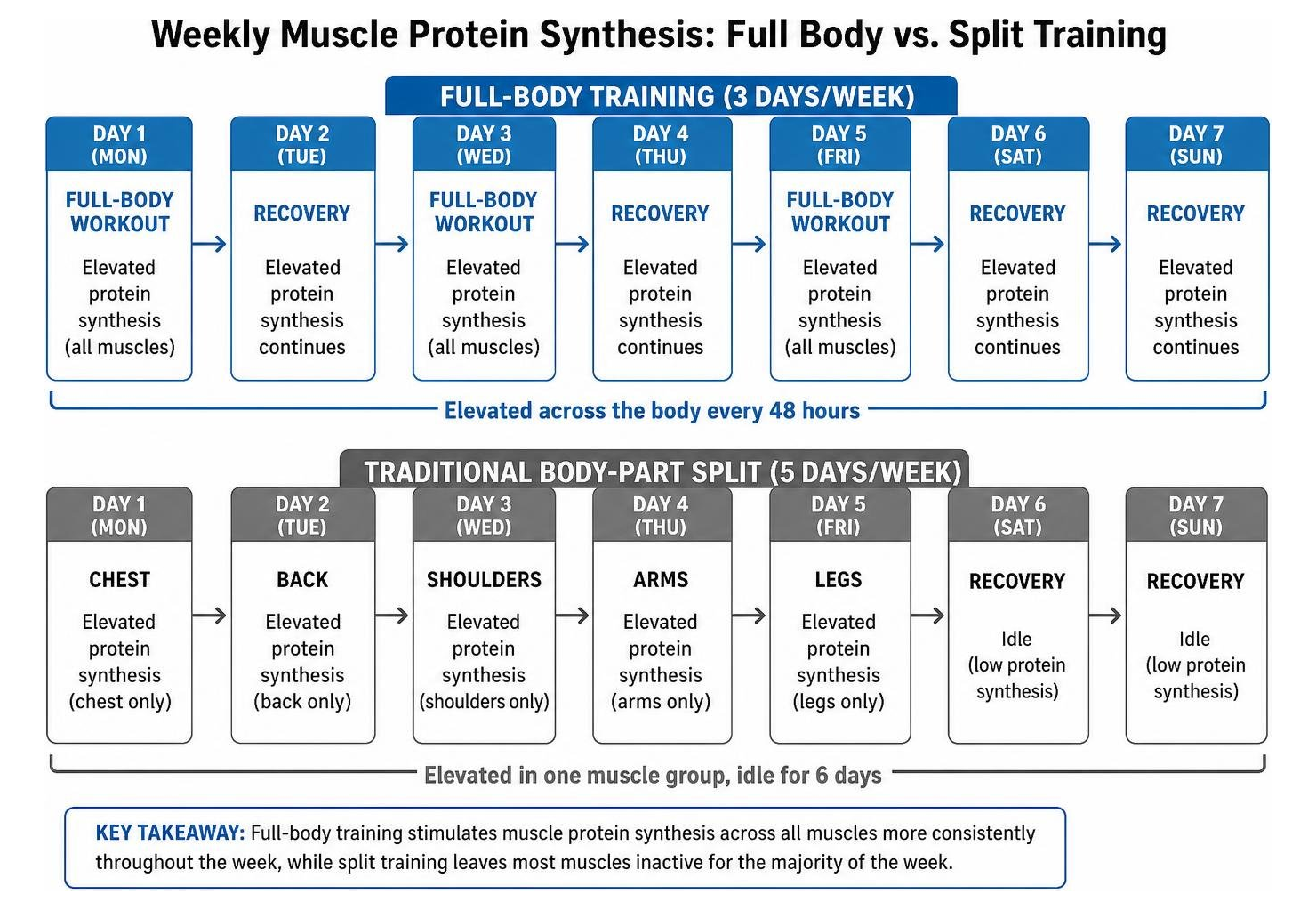
| Protein Synthesis Timing | Elevated across the body every 48 hours | Elevated in one muscle group, idle for 6 days |
| Session Scheduling Flexibility | High; missed days can be shifted easily | Low; a missed session disrupts the entire weekly rotation |
| Systemic Caloric Burn | High (large muscle mass recruited per session) | Moderate to low (isolated muscle groups) |
| Fatigue Distribution | Balanced across the body | Concentrated localized fatigue and deep muscle soreness |
Full-Body Frequency vs. Traditional Bro Splits
The traditional "bro split"—dedicating Monday to chest, Tuesday to back, Wednesday to shoulders, and so on—has long dominated bodybuilding culture. However, human muscle protein synthesis remains elevated for roughly 24 to 48 hours following a resistance training session before returning to baseline.
When you train a muscle only once per week, it spends roughly two days growing and four to five days in a static state. In contrast, hitting muscle groups across multiple full-body sessions per week keeps that anabolic window active far more consistently. By managing volume so you do not exceed your recovery capacity in any single workout, you stimulate steady muscle growth while keeping weekly fatigue manageable.
The Power of Unilateral Dumbbell Exercises
One of the greatest biomechanical advantages of training with dumbbells is the ability to perform unilateral movements—working one limb at a time. Bilateral exercises (like traditional barbell squats or bench presses) can allow your dominant side to compensate for your weaker side, subtly reinforcing muscle imbalances over time.
Dumbbells eliminate this compensation. Exercises like Bulgarian split squats, single-arm rows, and alternating presses force each side of your body to handle its load independently. This unilateral challenge demands deep core stabilization, enhances rotational strength, and refines joint mechanics. As highlighted in balance and stability research, unilateral training targets stabilizing muscles around the hips and shoulders, significantly lowering injury risk while building functional, real-world strength.
Essential Movement Patterns and Equipment Setup
To build a balanced, highly functional physique, your routine must be built around fundamental human movement patterns rather than isolated muscle groups:
- Squat Pattern: Knee-dominant lower body movement (e.g., Goblet Squat)
- Hinge Pattern: Hip-dominant posterior chain movement (e.g., Romanian Deadlift)
- Horizontal Push: Upper body pressing away from the torso (e.g., Dumbbell Flat Press / Floor Press)
- Horizontal Pull: Upper body rowing toward the torso (e.g., Single-Arm Dumbbell Row)
- Vertical Push: Upper body overhead pressing (e.g., Arnold Press)
- Locomotion/Carry: Core stabilization under dynamic load (e.g., Farmer's Walk)
To execute this routine at home, all you need is a reliable pair of adjustable dumbbells (or a small set of fixed hex dumbbells) and a sturdy flat bench. If you do not have a bench, a standard yoga mat on the floor works well for floor presses and bridging movements.
The Five Foundational Compound Lifts
Mastering these five multi-joint compound exercises ensures maximum muscle recruitment in minimal time:
- The Dumbbell Goblet Squat: Targets the quadriceps, glutes, and core. Holding a single heavy dumbbell vertically against your chest forces an upright torso, reducing lumbar shear stress while loading your legs deeply.
- The Dumbbell Romanian Deadlift (RDL): The premier hip-hinge movement for hamstring and glute development. By pushing the hips back with a soft knee bend, you create intense eccentric stretch through the posterior chain.
- The Dumbbell Floor Press / Flat Bench Press: Builds the pectorals, anterior deltoids, and triceps. Dumbbells allow a natural converging path for your hands, which spares the shoulder joints while maximizing chest contraction.
- The Single-Arm Bent-Over Row: Recruits the latissimus dorsi, rhomboids, rear delts, and biceps. Unilateral rowing lets you pull along your natural anatomical arc, maximizing back activation without lower-back strain.
- The Standing Arnold Press: Provides comprehensive shoulder development by rotating the dumbbells through a dynamic arc from palms-in to palms-out, engaging the front, lateral, and rear deltoid heads.
Beginner Modifications for a 1 Hour Full Body Workout with Dumbbells
If you are new to strength training or returning after a break, you can easily modify these movements to match your current fitness level:
- Goblet Squat Regressions: Start with bodyweight box squats, sitting back onto a chair to master depth and hip placement before adding weight.
- RDL Adjustments: Practice the hip hinge against a wall—stand a foot away and push your hips backward until your glutes touch the wall—using light weights or just your bodyweight.
- Floor Presses: Use the floor instead of a bench. The floor naturally limits the bottom range of motion, protecting your shoulder capsule from overextending.
- Tempo Control: Slow down the lowering (eccentric) phase to 3-4 seconds with lighter weights. This builds motor control and tendon resilience without requiring heavy loads.
Complete Blueprint for a 1 Hour Full Body Workout with Dumbbells
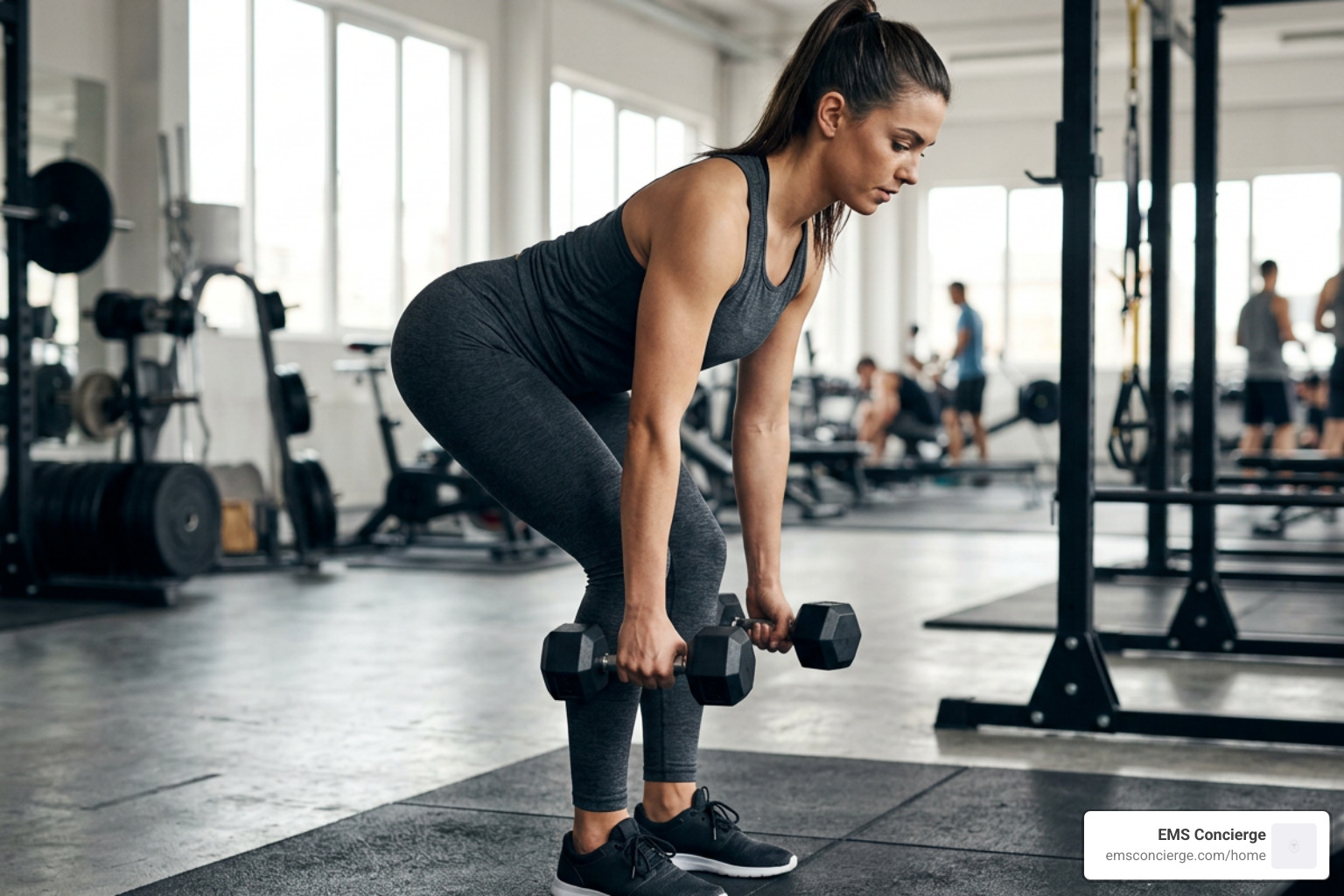
To maximize your 60 minutes, this routine organizes exercises into non-competing supersets (antagonist pairings). Pairing an upper-body push with a lower-body pull, or a squat with an upper-body row, allows one muscle group to rest and recover while the other is actively working. This doubles your workout density without requiring lengthy rest periods.
Following principles for optimizing 60-minute training volume, this structure keeps your heart rate elevated and maximizes muscle fiber recruitment within an exact 60-minute timeframe.
Structuring Your 1 Hour Full Body Workout with Dumbbells for Maximum Hypertrophy
- Warm-Up (0:00 – 0:08): Dynamic mobility, hip openers, cat-cows, arm circles, and unweighted bodyweight squats.
- Block A – Heavy Compound Superset (0:08 – 0:24): Squat & Horizontal Pull (3 rounds).
- Block B – Posterior Chain & Upper Push Superset (0:24 – 0:40): Hip Hinge & Horizontal Press (3 rounds).
- Block C – Unilateral & Vertical Push Superset (0:40 – 0:52): Unilateral Leg & Overhead Press (3 rounds).
- Block D – Metabolic Core & Grip Finisher (0:52 – 0:57): Loaded Carries & Core Integration (2 rounds).
- Cool-Down & Stretch (0:57 – 1:00): Gentle decompression, hamstring stretching, and deep breathing.
Target the 8–15 repetition range for your compound lifts. For muscle growth, perform each set with an intensity that leaves approximately 1 to 2 reps in reserve (RIR)—meaning you could only perform one or two more clean reps before technical failure.
The 60-Minute Dumbbell Exercise Protocol
Superset Block A (16 Minutes)
Perform Exercise A1, rest 45 seconds, perform Exercise A2, rest 60 seconds. Repeat for 3 total working sets.
- A1: Dumbbell Goblet Squat
Sets: 3 | Reps: 10–12 | Tempo: 3-0-1-0 (3 seconds down, explosive up)
Execution: Hold one heavy dumbbell vertically at your collarbone. Keep your elbows tucked, push your knees out in line with your toes, sink your hips between your heels until your thighs break parallel, and drive up through your midfoot. - A2: Single-Arm Bent-Over Dumbbell Row
Sets: 3 | Reps: 10–12 per side | Tempo: 2-0-1-1 (1-second squeeze at the top)
Execution: Place your non-working hand and knee on a bench (or hinge forward with a flat back). Pull the dumbbell back toward your hip pocket, keeping your elbow tight to your side. Squeeze your lat at the peak before lowering under control.
Superset Block B (16 Minutes)
Perform Exercise B1, rest 45 seconds, perform Exercise B2, rest 60 seconds. Repeat for 3 total working sets.
- B1: Dumbbell Romanian Deadlift (RDL)
Sets: 3 | Reps: 10–12 | Tempo: 3-1-1-0
Execution: Stand with feet hip-width apart, holding dumbbells at your thighs. Hinge backward at your hips with a slight bend in your knees and a flat spine. Lower the weights just past your knees until you feel a deep stretch in your hamstrings, then drive your hips forward to lock out. - B2: Flat Dumbbell Bench Press (or Floor Press)
Sets: 3 | Reps: 8–12 | Tempo: 2-1-1-0
Execution: Lie back on a bench or the floor with dumbbells at shoulder height, palms angled slightly inward (45 degrees). Press up smoothly over your mid-chest without clanking the weights together, then lower under control until your elbows reach chest level.
Superset Block C (12 Minutes)
Perform Exercise C1, rest 45 seconds, perform Exercise C2, rest 60 seconds. Repeat for 3 total working sets.
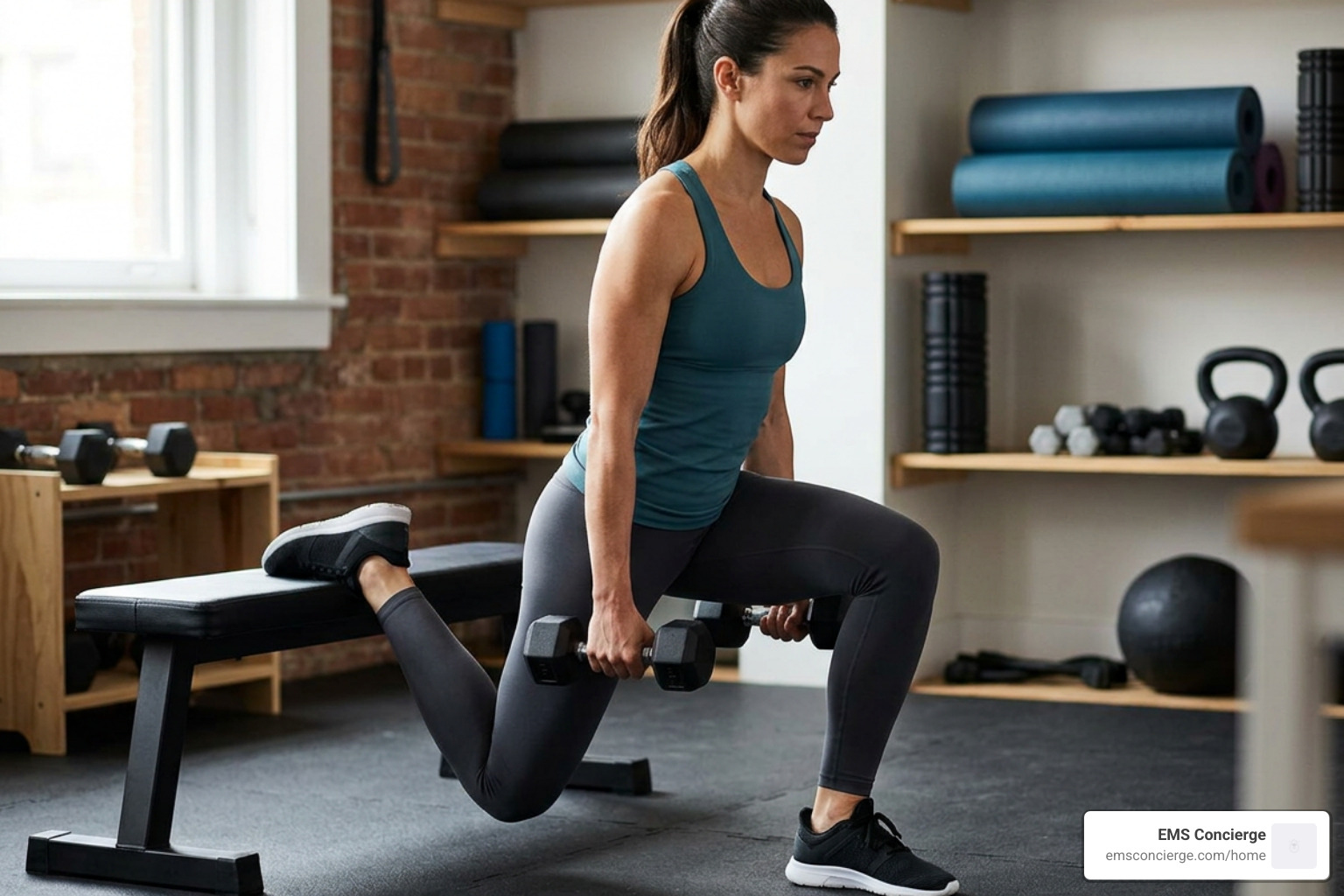
- C1: Dumbbell Bulgarian Split Squat
Sets: 3 | Reps: 8–10 per side | Tempo: 2-0-1-0
Execution: Place your rear foot laces-down on a bench or elevated surface. Step your front foot forward into a lunge stance. Lower your back knee toward the floor while keeping your front shin relatively vertical and torso slightly leaning forward to load the front glute and quad. - C2: Standing Dumbbell Arnold Press
Sets: 3 | Reps: 10–12 | Tempo: 2-0-1-0
Execution: Stand tall with feet shoulder-width apart, holding dumbbells at chin height with palms facing you. As you press overhead, rotate your wrists outward so your palms face forward at full lockout. Reverse the motion smoothly on the descent.
Finisher Block D (5 Minutes)
Perform D1 and D2 continuously as a circuit for 2 total rounds.
- D1: Dumbbell Farmer's Carry
Sets: 2 | Duration: 45 seconds of continuous walking | Weight: Heavy
Execution: Pick up your heaviest pair of dumbbells. Stand tall with your shoulders pulled down and back, core braced. Walk with slow, controlled heel-to-toe steps without letting the dumbbells swing or sway against your legs. - D2: Dumbbell Plank Pull-Through
Sets: 2 | Reps: 12 total pulls (6 per side)
Execution: Set up in a high push-up plank with a dumbbell resting behind your right wrist. Reach your left hand across your body, grab the dumbbell, drag it across the floor to the left side, and place your hand down. Repeat with the opposite arm while keeping your hips level.
Progressive Overload and Time-Saving Training Strategies
Muscles do not grow simply from doing a workout; they grow from adapting to a stimulus that challenges them over time. This is the fundamental rule of progressive overload.
When training with dumbbells at home, you may eventually reach the maximum weight available in your set. Fortunately, progressive overload encompasses multiple training variables beyond simply grabbing a heavier pair of weights:
- Repetition Progression: Increase your rep count over time (e.g., from 8 reps to 12 reps with the same weight across multiple weeks).
- Eccentric Tempo: Slow the lowering phase of each lift from 2 seconds to 4 seconds, increasing mechanical tension and muscle fiber recruitment.
- Pause Repetitions: Add a 1- to 2-second isometric pause at the bottom of a goblet squat or RDL to remove momentum and demand greater force production.
- Reduced Rest Intervals: Complete the same volume of work in slightly less time, boosting your metabolic density and conditioning.
- Range of Motion: Elevate your front foot on a small platform during split squats to increase hip flexion and target muscle stretch.
Applying Progressive Overload Without Heavier Weights
To systematically progress your home routine, use a "double progression" model:
- Pick a target weight where you can achieve 8 clean repetitions with 2 reps left in the tank.
- Keep that same weight until you can perform 12 clean repetitions with good form across all prescribed sets.
- Once you hit 12 reps on all sets, either increase the dumbbell load by 5 pounds and reset to 8 reps, or add a 3-second eccentric tempo if you don't have heavier weights.
This clear method ensures steady progress while protecting your joints and connective tissues from premature overload.
Evaluating Home Strength vs. Advanced Fitness Alternatives
A 60-minute dumbbell routine is one of the most practical, accessible ways to build muscle, strengthen joints, and burn calories at home. However, achieving deep muscle fatigue with free weights requires strict focus on form, high mental effort, and consistent time allocation every week.
For busy professionals, parents, and frequent travelers, dedicating 3 to 4 full hours every week to home strength training can be tough to sustain. When balancing career and family commitments, exploring modern technologies offers an alternative approach to strength development.
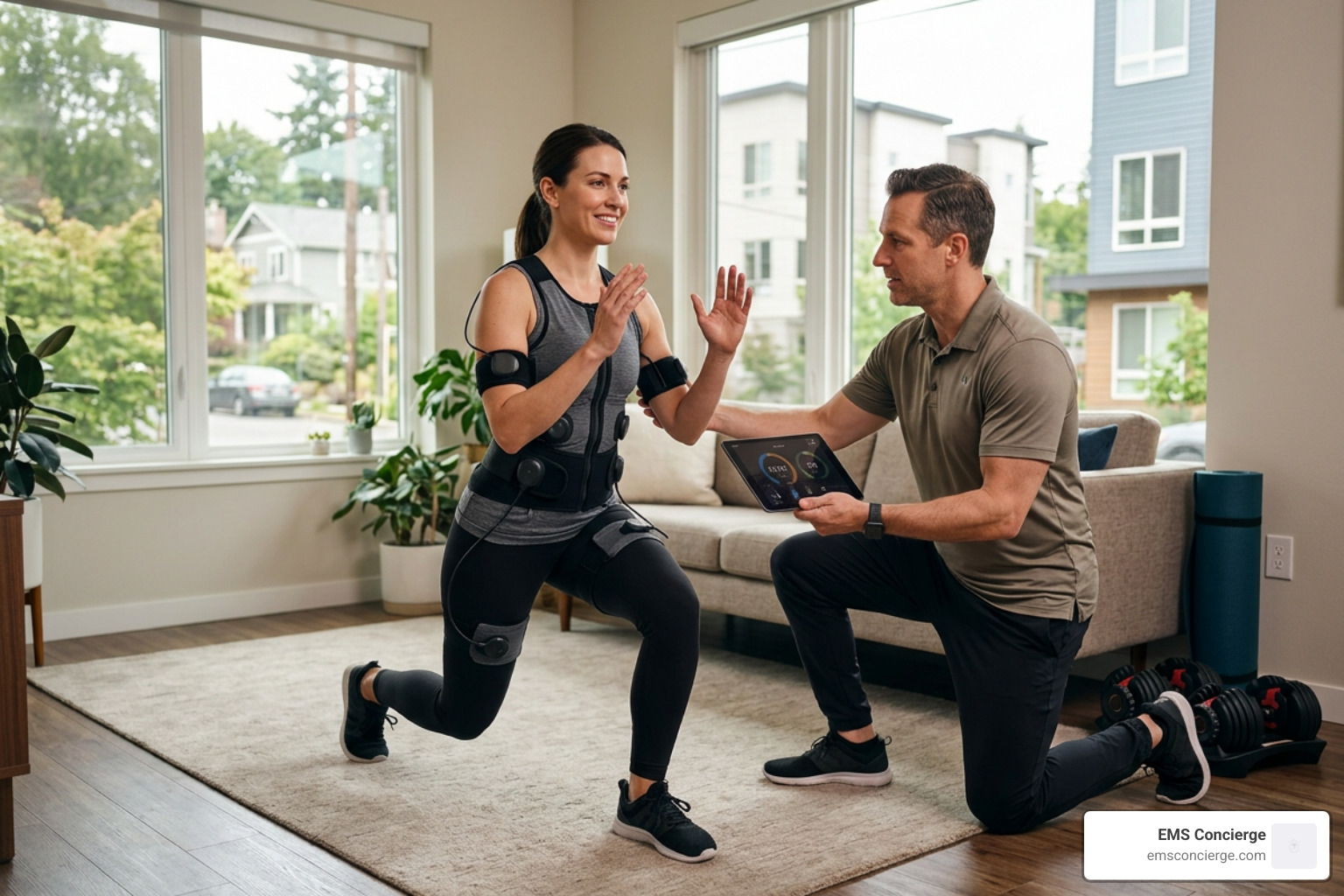
If you are interested in comparing different modalities, reading our guide comparing home dumbbell lifting to modern training alternatives provides a clear look at how technology-driven fitness matches up against traditional free weights. For those seeking maximum muscle activation in a fraction of the time, upgrading your weekly workout routine with targeted electro-muscle stimulation (EMS) provides gym-level muscular contractions in a single 20-minute session.
Frequently Asked Questions About Dumbbell Full-Body Training
Can you build significant muscle using only dumbbells?
Yes. Your skeletal muscles recognize mechanical tension, metabolic stress, and muscle damage—they do not know whether resistance comes from a barbell, a specialized gym machine, or a pair of dumbbells. By training within 1 to 3 repetitions of muscular failure and applying progressive overload across the 8–15 rep range, dumbbells provide all the stimulus needed for substantial muscle hypertrophy.
How many times per week should you perform a 60-minute full-body workout?
For most individuals, performing a full-body routine 3 days per week on non-consecutive days (e.g., Monday, Wednesday, Friday) is ideal. This schedule hits every muscle group three times weekly while allowing a full 48-hour recovery window between sessions for muscle tissue repair and central nervous system recovery.
What are the best compound dumbbell exercises for total-body strength?
The most effective compound dumbbell exercises are multi-joint movements that recruit large amounts of muscle mass:
- Goblet Squats & Bulgarian Split Squats for quadriceps and glutes
- Romanian Deadlifts for the hamstrings and posterior chain
- Flat/Incline Dumbbell Presses for the chest, shoulders, and triceps
- Single-Arm Bent-Over Rows for the back, rear deltoids, and biceps
- Standing Arnold Presses for complete deltoid activation
Conclusion
Building a strong, muscular, and resilient body does not require a commercial gym membership or complicated machines. By committing to this structured 60-minute full-body dumbbell routine, focusing on fundamental compound movements, and consistently applying progressive overload, you can achieve remarkable muscle growth and functional strength at home.
At EMS Concierge, we believe your training should work seamlessly with your life, not complicate it. Whether you are lifting free weights in your living room or looking to accelerate your results through customized full-body EMS training sessions, consistency is key. Pick up your weights, stay committed to the process, and enjoy the journey to a stronger physique.