What Is an EMS Cycling Workout and How Does It Work?
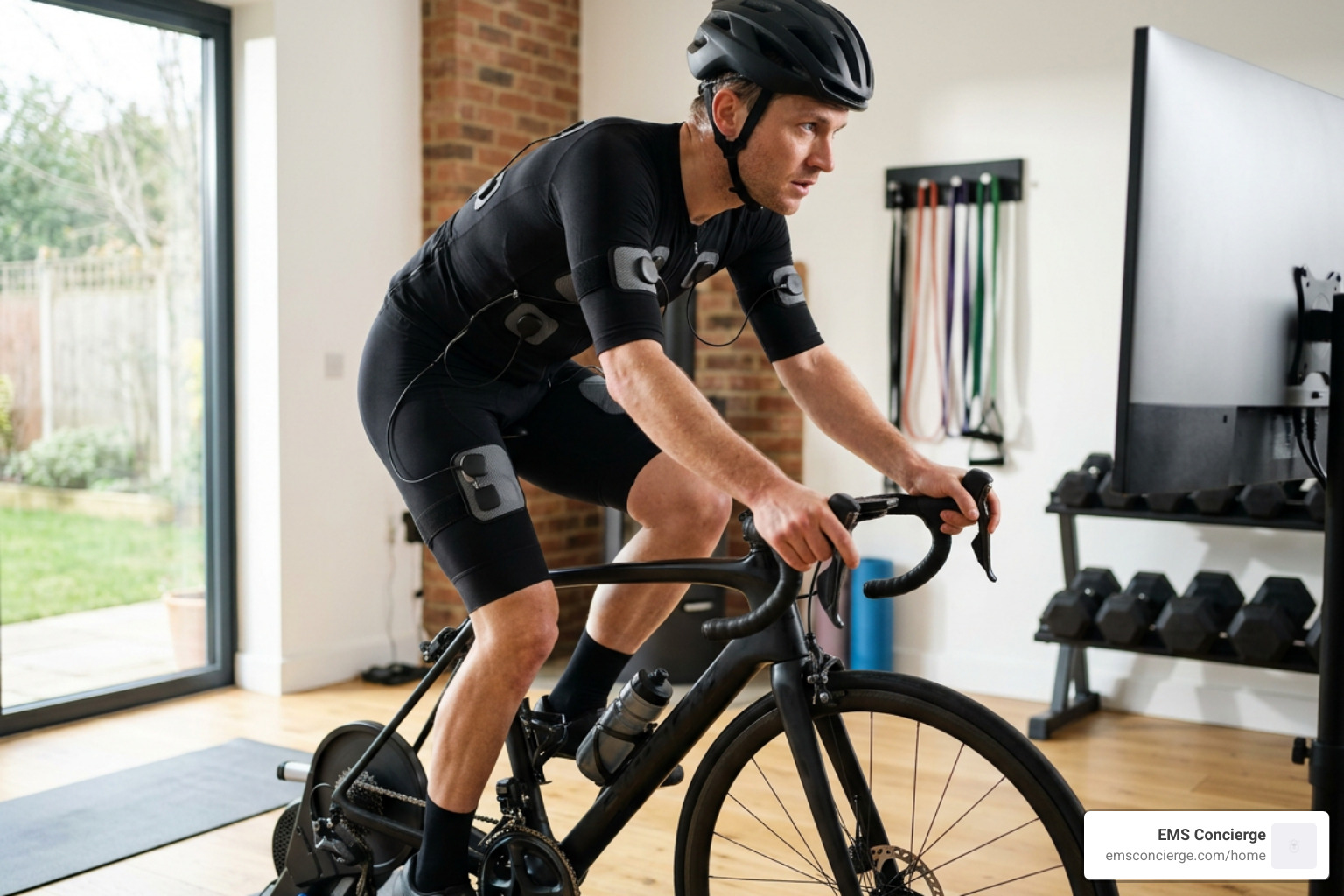
At its core, an EMS cycling session superimposes low-to-medium frequency electrical impulses onto your natural pedaling motion. When you pedal a bike normally, your central nervous system sends electrical signals down your motor neurons, prompting muscle fibers to contract. This is voluntary muscle recruitment.
Superimposed electromyostimulation (EMS) bypasses this purely central pathway by sending external electrical impulses directly through skin-contact electrodes. These impulses stimulate the peripheral motor nerves, triggering an involuntary contraction on top of whatever force your brain is actively telling your legs to produce.
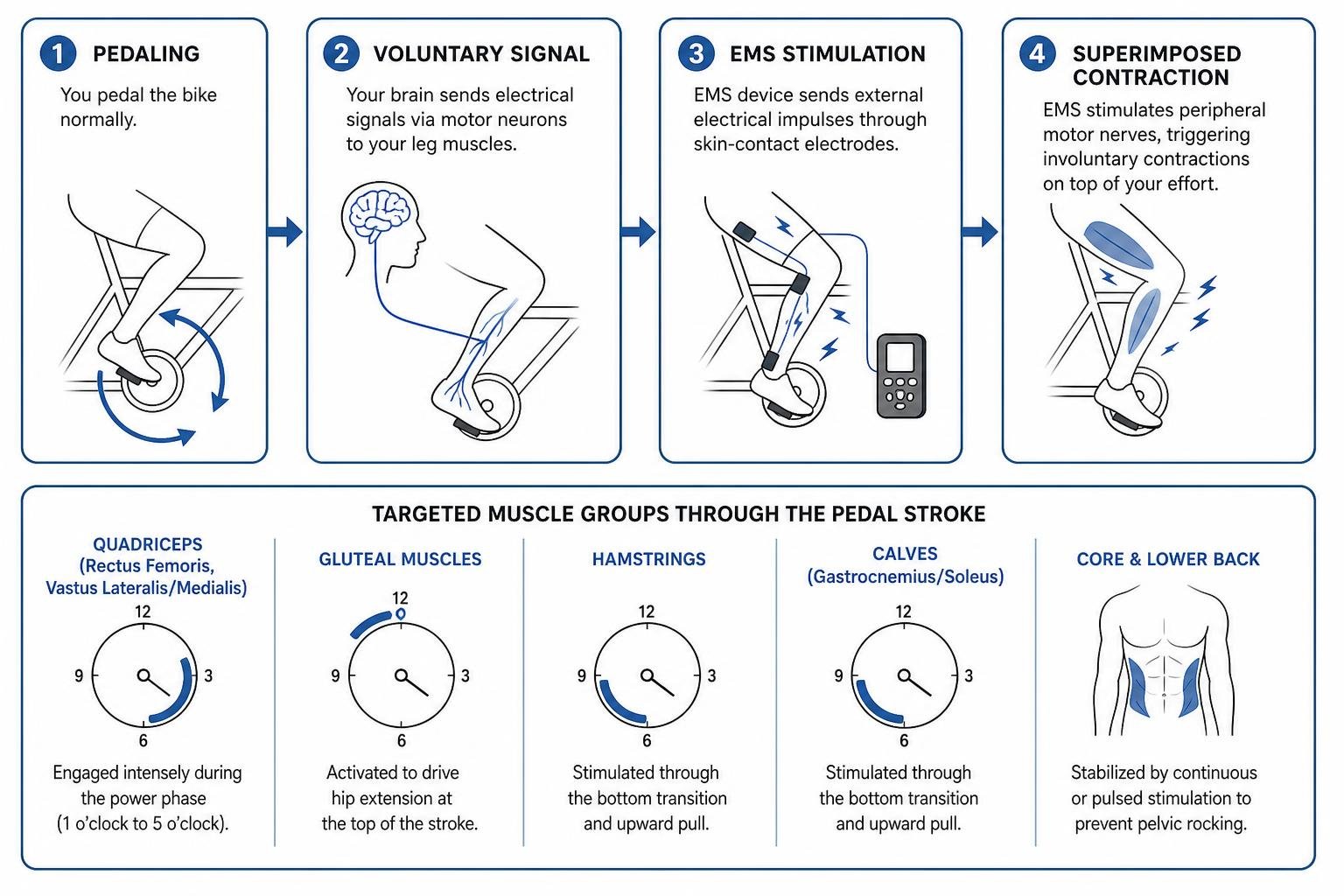
When applied during cycling, the technology targets specific muscle groups across the entire pedal stroke:
- Quadriceps (Rectus Femoris, Vastus Lateralis/Medialis): Engaged during the power phase (from 1 o'clock to 5 o'clock on the pedal stroke).
- Gluteal Muscles: Activated to drive hip extension at the top of the stroke.
- Hamstrings and Calves (Gastrocnemius/Soleus): Stimulated through the bottom transition and upward pull.
- Core and Lower Back: Stabilized by continuous or pulsed stimulation to prevent pelvic rocking.
This concurrent stimulation increases local metabolic demand and motor unit recruitment without requiring heavy mechanical gear resistance that could stress your knees and hips.
Essential Gear for an EMS Cycling Workout
To perform this hybrid workout effectively, you need a precise combination of cycling hardware and stimulation gear:
- Professional-Grade EMS Suit or Strap System: A well-fitted suit housing medical-grade electrodes that target the quads, hamstrings, glutes, core, and back.
- Electrode Control Unit: A console or wireless generator that manages pulse frequency (Hz), impulse width (depth in microseconds), and intensity channels for each muscle group.
- Smart Trainer or Stationary Ergometer: Direct-drive smart trainers provide steady resistance and allow you to measure metrics accurately.
- Power Meter and Cadence Sensor: Crucial for monitoring whether changes in output stem from voluntary effort or EMS-driven torque.
- Electrode Undergarments: Breathable, moisture-wicking functional layers lightly sprayed with water to ensure optimal electrical conductivity between pads and skin.
Neuromuscular Mechanics and Fiber Recruitment
Under normal cycling conditions, your body follows Henneman’s size principle. It activates small, fatigue-resistant Type I (slow-twitch) muscle fibers first. Only when intensity spikes or endurance runs low does your nervous system recruit larger, force-generating Type II (fast-twitch) fibers.
EMS changes this recruitment order. Electrical impulses activate motor units non-selectively and synchronously. This means fast-twitch fibers—which are notoriously difficult to tap into without sprinting at maximum effort or lifting heavy weights—contract even at low cadences and moderate power outputs.
By superimposing EMS onto smooth pedaling mechanics, you train these high-threshold motor units to fire while your cardiovascular system manages the aerobic demands of the ride.
Key Benefits of Superimposed EMS for Cyclists
Integrating EMS into your saddle time offers distinct physiological adaptations that complement traditional endurance miles.
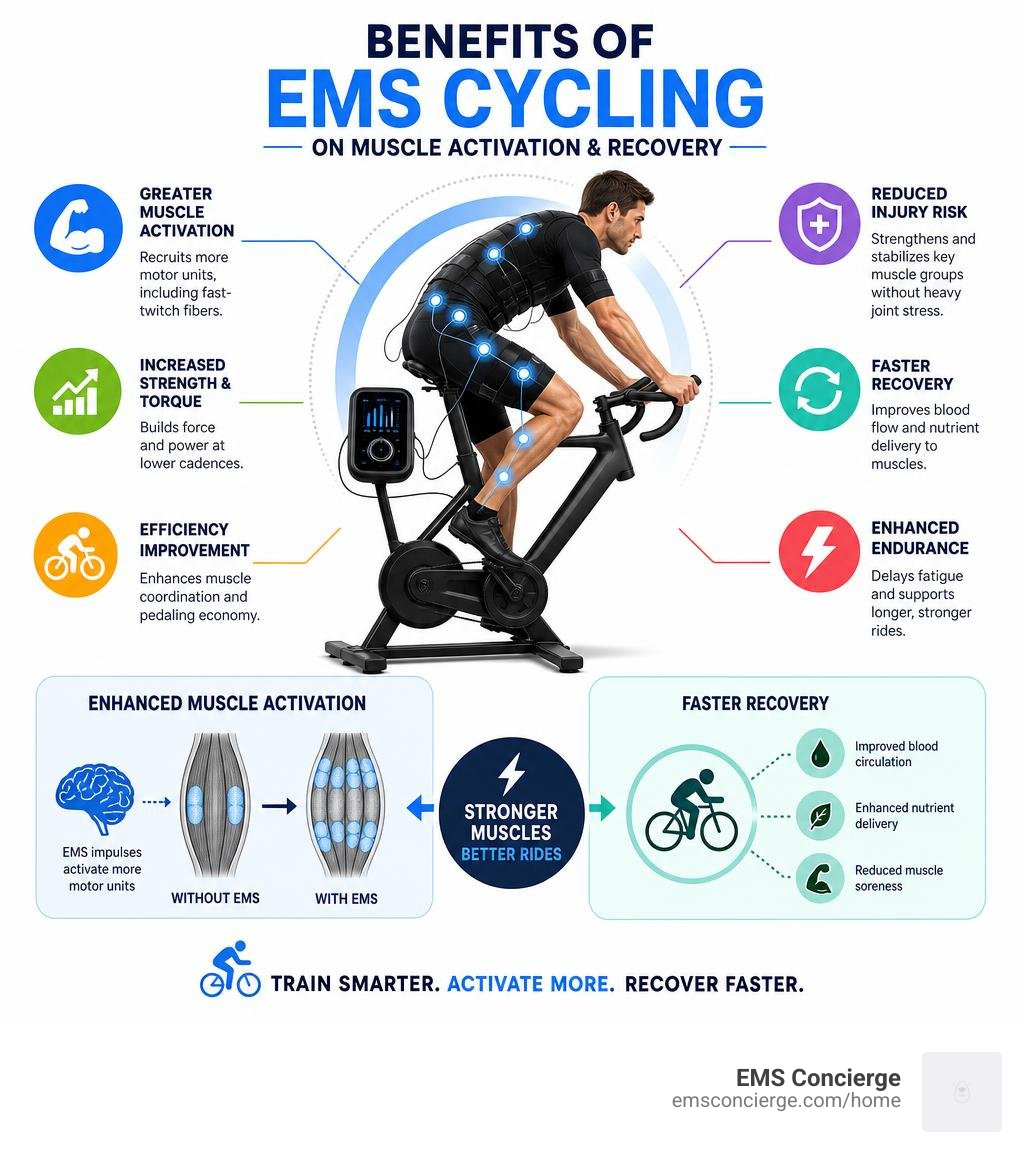
Muscular Strength and Torque Production
Generating high torque at low cadences is one of the most effective ways to build cycling-specific leg strength. Many coaches utilize big-gear, low-cadence intervals (often 65–75 RPM) to build force per pedal stroke. For instance, classic strength sessions—like Emma Snowsill's bike strength training principles—emphasize sustained high-torque intervals to develop muscular stamina for climbing and time trials.
When you add superimposed EMS to low-cadence efforts, you artificially amplify the force of contraction within the quadriceps and glutes. This stimulates neuromuscular adaptations similar to heavy gym-based resistance training, but within the exact movement pattern of your pedal stroke.
Active Recovery and Metabolic Clearance
EMS is not just for high-intensity work; it also excels at recovery. Swapping high-frequency strength impulses (70–85 Hz) for low-frequency recovery programs (1–7 Hz) creates a rhythmic, muscle-pump effect.
This low-intensity twitching promotes localized circulation, dilates capillary beds, and accelerates the clearance of metabolic byproducts without taxing your cardiovascular system. Using a gentle recovery program on a stationary bike helps alleviate delayed-onset muscle soreness (DOMS) while keeping your joints completely unloaded.
Scientific evaluations offer a balanced perspective on these adaptations. Research on superimposed electromyostimulation during cycling (Mathes et al., 2017) demonstrates that while superimposed EMS significantly elevates metabolic stress and markers of muscular exertion, it produces aerobic and anaerobic gains comparable to traditional cycling protocols.
Rather than viewing EMS as a magic shortcut that outperforms regular training, smart cyclists treat it as a time-efficient tool to achieve deep muscular activation in shorter, low-impact training blocks.
Comparing EMS-Augmented Cycling with Traditional Training
To understand where EMS fits into your routine, it helps to compare its physiological footprint with standard indoor cycling.
| Training Parameter | Traditional Indoor Cycling | EMS-Augmented Cycling |
|---|---|---|
| Typical Session Duration | 60–90 minutes | 20 minutes |
| Fiber Recruitment Pattern | Hierarchical (Type I to Type II) | Non-selective / Synchronous (Type I & II together) |
| Joint Mechanical Load | Moderate to High (requires heavy resistance) | Very Low (muscle contracts via impulse, not gear load) |
| Muscular Metabolic Strain | Proportional to wattage | Amplified beyond baseline mechanical wattage |
| Cardiovascular Strain | Primary driver of session stress | Moderate to High (due to elevated peripheral demand) |
| Primary Training Focus | Aerobic base, pacing, cycling economy | Neuromuscular strength, torque, time efficiency |
How to Integrate EMS into Your Cycling Regimen
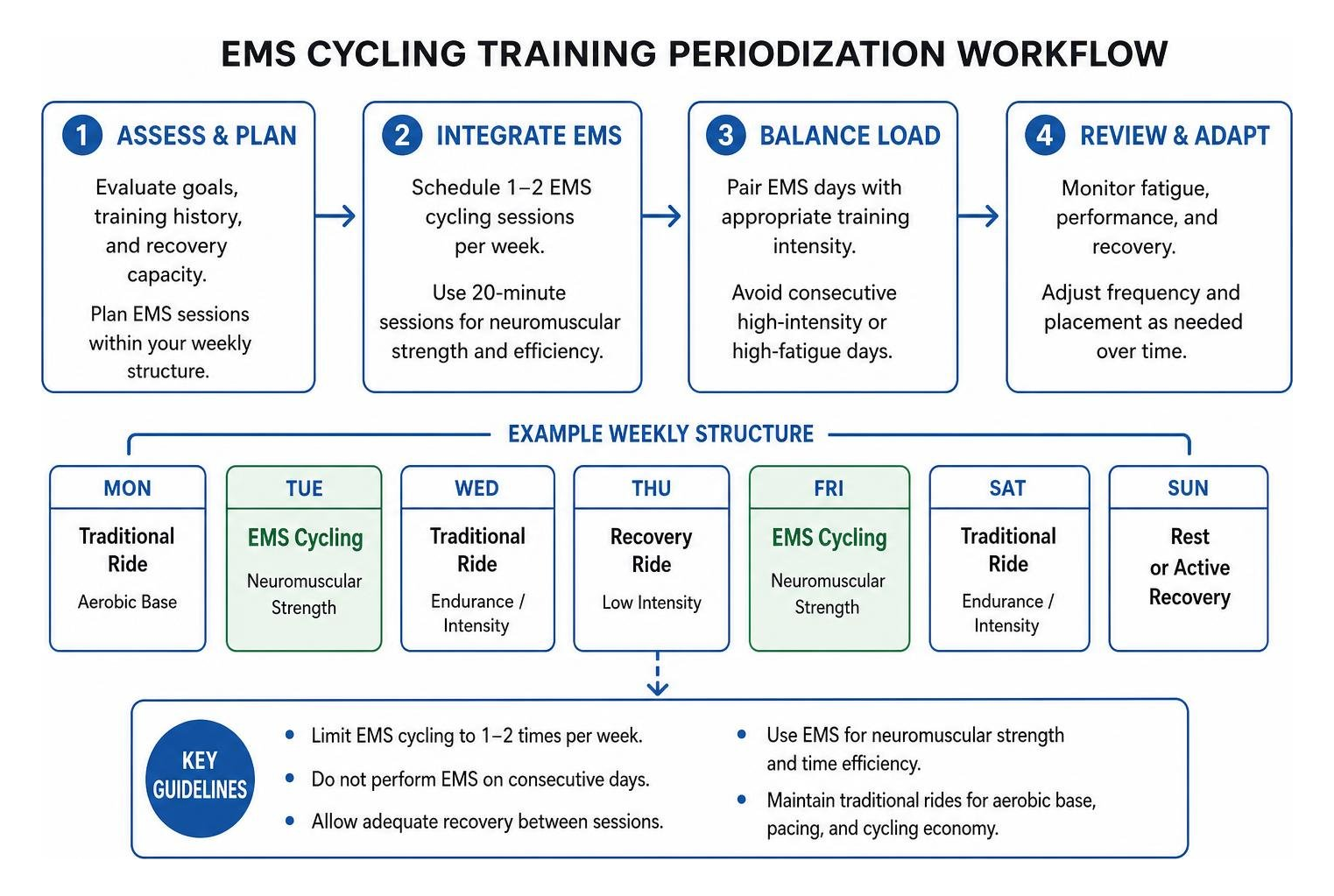
Balancing EMS with conventional riding requires thoughtful periodization. Because EMS induces greater peripheral fatigue and structural muscle stress than standard spinning, it should not be performed daily.
Structuring a 20-Minute EMS Cycling Workout
A structured 20-minute session balances warm-up, high-torque stimulation intervals, and active recovery.
1. Warm-Up (Minutes 0:00 – 5:00)
- Cycling Intensity: Level II easy spin (55–65% FTP), cadence 85–90 RPM.
- EMS Setting: Low-frequency warm-up impulse (5–10 Hz) or very low intensity (below motor threshold).
- Goal: Increase tissue temperature, establish comfortable electrode contact, and settle into a smooth rhythm.
2. Main Strength & Torque Interval Block (Minutes 5:00 – 17:00)
- Format: 3 sets of 3 minutes at high torque, with 1 minute of light spinning between sets.
- Cycling Intensity: Moderate resistance (Level III to Level IV), cadence locked at 65–75 RPM.
- EMS Setting: 75–85 Hz impulse frequency, calibrated to a challenging but tolerable contraction intensity (7/10 effort). Impulse cycle: 4 seconds on (during pedal downstroke emphasis), 4 seconds off.
- Goal: Maximize motor unit recruitment in the quads, glutes, and core without losing smooth pedal technique.
3. Cool-Down & Metabolic Flush (Minutes 17:00 – 20:00)
- Cycling Intensity: Level I–II very light resistance, cadence 90 RPM.
- EMS Setting: Recovery mode (2–4 Hz continuous tap).
- Goal: Encourage blood flow, reduce muscle tension, and begin active recovery.
Combining EMS with Low-Cadence Strength Protocols
When the stimulation kicks in during a heavy interval, your body’s natural reaction might be to tense your shoulders or alter your pedal stroke. Keep these best practices in mind:
- Stabilize Your Core: Anchor through your pelvis and keep your lower back neutral. Do not rock side-to-side.
- Relax Your Upper Body: Keep a light grip on the handlebars. Let your legs and hips absorb the electrical stimulus.
- Maintain Cadence Consistency: If the impulse causes your cadence to drop below 60 RPM, dial back either the bike resistance or the EMS channel intensity. Smooth mechanics always come before raw power.
Safety Considerations, Contraindications, and Best Practices
Because superimposed EMS activates muscle tissue so deeply, safety and gradual progression are essential.
- Hydration Is Non-Negotiable: Deep contractions produce metabolic waste products such as creatine kinase (CK). Drink plenty of water before and after every session to support kidney function and muscle recovery.
- Manage Training Volume: Limit high-intensity EMS cycling to 1–2 sessions per week. Allow at least 48 hours between workouts to allow muscle tissue to rebuild.
- Calibrate Intensity Gradually: Never start a session at maximum impulse. Increase the intensity channel by channel once your pedaling cadence is stable.
- Recognize Contraindications: EMS training is not suitable for individuals with cardiac pacemakers, active implantable medical devices, epilepsy, pregnancy, or acute circulatory disorders. Always consult a physician before starting an EMS program.
Frequently Asked Questions About EMS Cycling
How often should I do an EMS cycling session?
For most cyclists, 1 to 2 sessions per week is the sweet spot. This provides sufficient neuromuscular overload to build torque and strength while leaving plenty of recovery time for endurance rides and interval work.
Does superimposed EMS replace long endurance rides?
No. While EMS is effective for building muscular strength and local metabolic capacity in a 20-minute window, it does not replicate the thermoregulatory, fueling, and cardiovascular adaptations of a 3- to 4-hour weekend base ride. It works best as a supplemental training tool alongside regular road or trainer miles.
Can EMS cycling workouts improve FTP and sprint power?
Yes, indirectly. By training high-threshold Type II motor units to fire more efficiently and increasing torque tolerance at lower cadences, EMS builds the muscular foundation needed to sustain higher functional threshold power (FTP) and produce greater peak power during sprints.
Conclusion
Superimposed EMS cycling bridges the gap between gym-based strength work and cycling-specific endurance. By engaging deep fast-twitch muscle fibers on a stationary bike, you can build torque, protect your joints from excessive mechanical strain, and accelerate recovery—all within a compact 20-minute session.
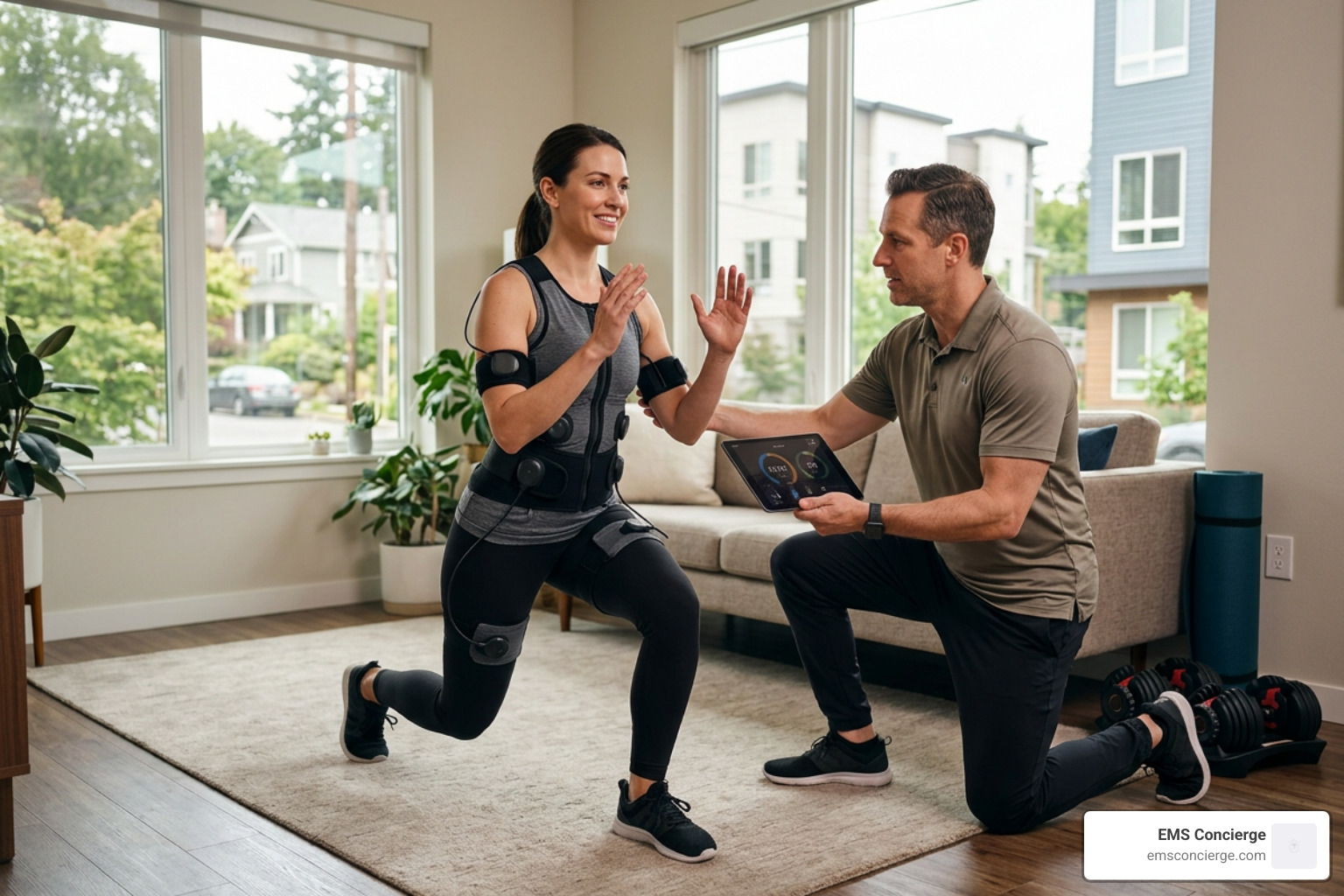
At EMS Concierge, we bring this training approach directly to your home. Using professional-grade Miha Bodytec systems, our certified trainers guide you through customized, low-impact workouts designed around your fitness goals. If you are looking to elevate your cardiovascular fitness and build functional strength without spending hours in the gym, explore our cardio program and experience the benefits of guided neuromuscular stimulation firsthand.
References
Mathes S, Lehnen N, Link T, Bloch W, Mester J, Wahl P. "Chronic effects of superimposed electromyostimulation during cycling on aerobic and anaerobic capacity.." European journal of applied physiology, 2017. PMID 28271312.