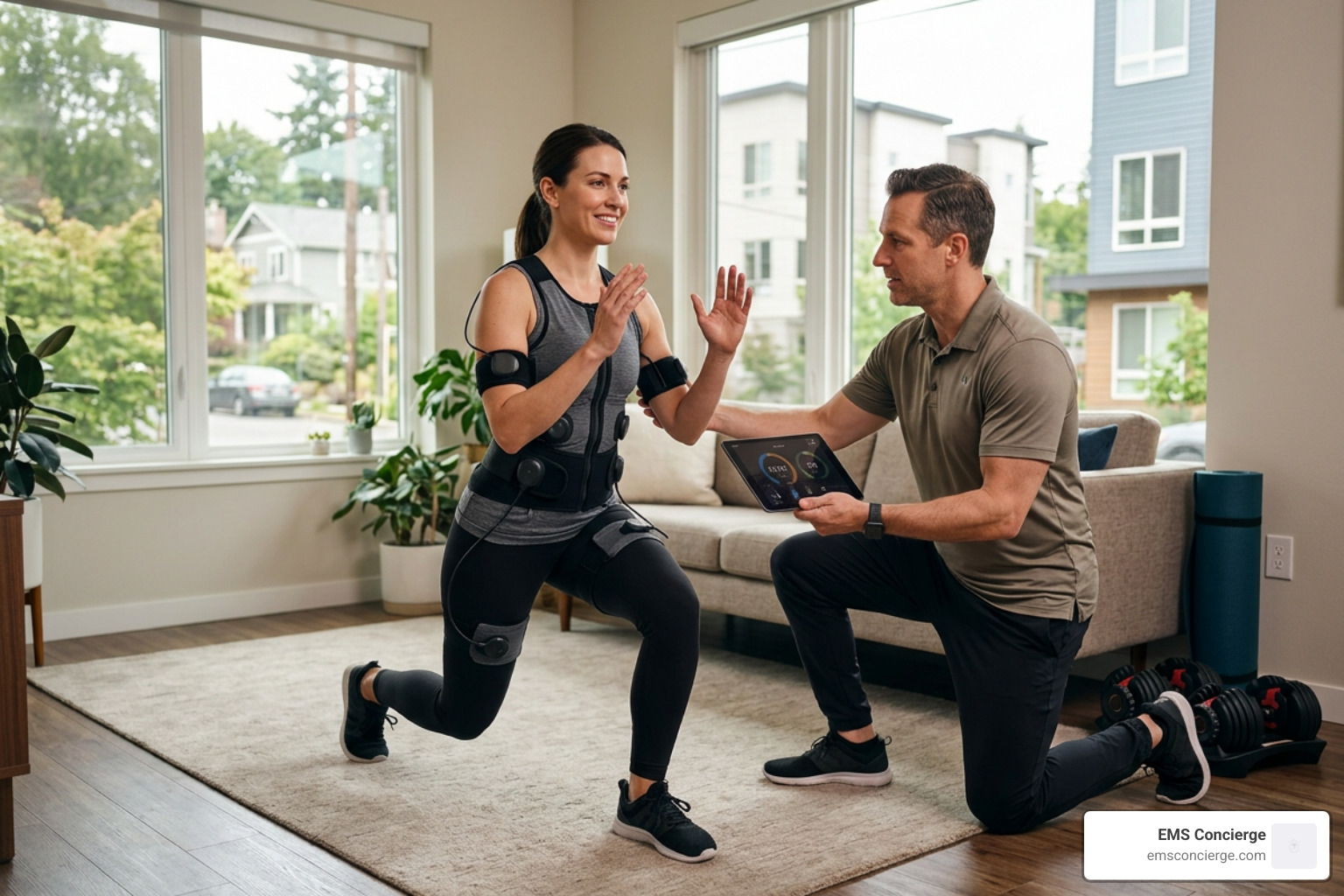
Estimate Calories Burned in an EMS Workout
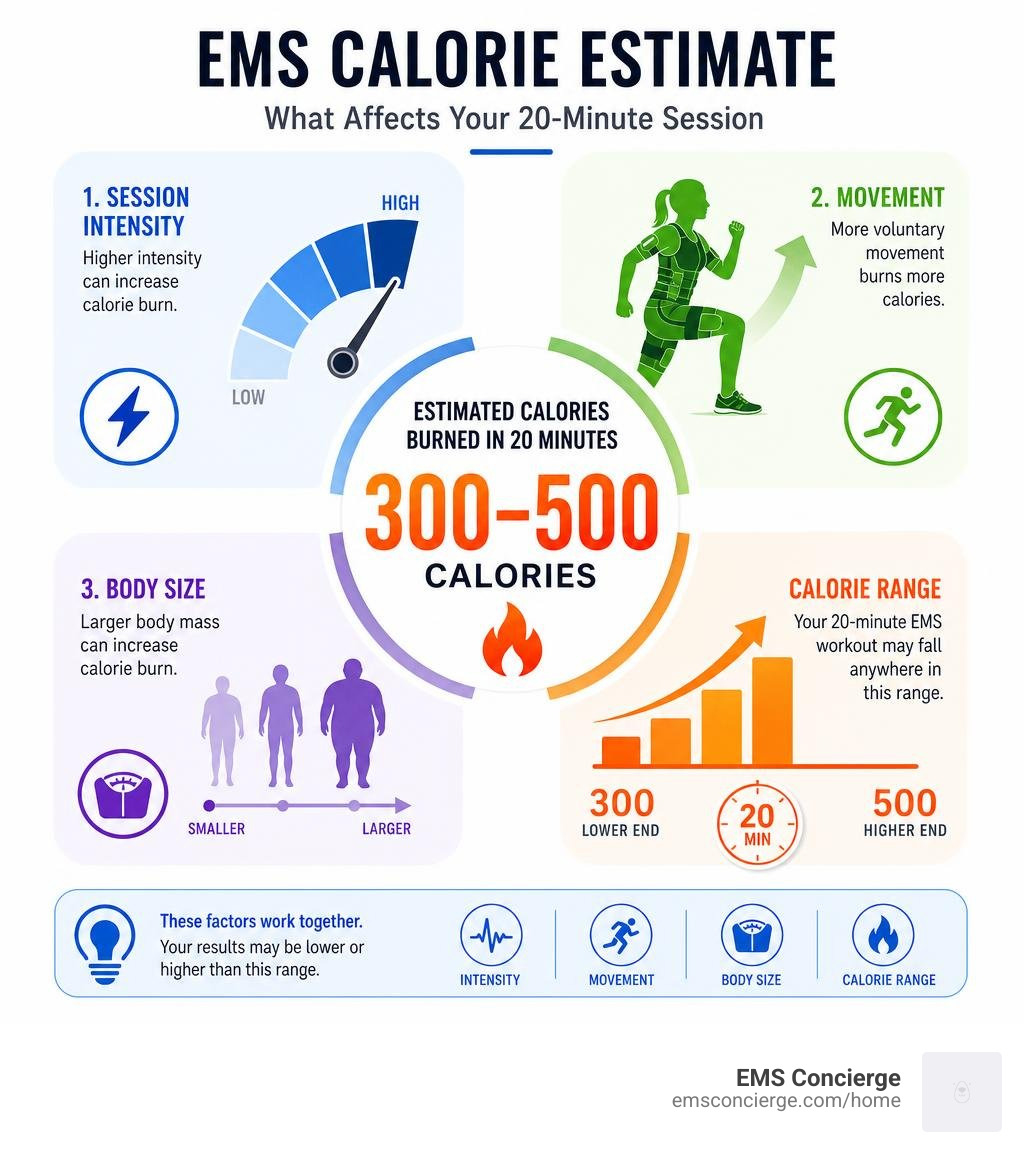
A full-body EMS workout may burn roughly 300 to 500 calories in 20 minutes in some studio-based estimates, but your real number can be lower or higher. The biggest drivers are stimulation intensity, how much voluntary movement you do, the muscle groups trained, and your body size.
To estimate your calories burned in an EMS workout more honestly:
- Treat 300 to 500 calories as a high-intensity full-body session estimate, not a guarantee.
- Expect a smaller increase when EMS is used while sitting still or at a gentle setting.
- Use EMS alongside a calorie-controlled diet, walking, cardio, and strength work rather than counting on one short session to create your whole weekly deficit.
EMS makes muscles contract through electrical impulses while you perform controlled movements. That can raise energy use compared with the same light activity without stimulation. Research also suggests the increase scales with tolerable intensity, while the post-session "afterburn" appears modest and short-lived.
For a busy professional, the appeal is clear: a supervised, low-impact session can train many major muscle groups without the time, crowds, or pounding of a long gym workout. But calorie math still matters. Fat loss comes from a consistent energy deficit over time, not from an EMS suit alone.
Calories Burned EMS Workout Breakdown: What the Science Proves
When evaluating the calories burned ems workout sessions produce, we have to look past marketing buzzwords and examine the physiological mechanisms at play. Whole-body electro-muscle stimulation (WB-EMS) recruits motor units simultaneously across large muscle groups—including your quadriceps, glutes, core, back, and chest—bypassing the body's natural recruitment hierarchy.
Scientific literature shows that neuromuscular electrical stimulation (NMES) reliably increases metabolic demand. In a landmark clinical study investigating energy expenditure across sensory, motor threshold, and maximal comfortable stimulation levels, researchers confirmed that stimulation significantly increases active oxygen consumption and calorie expenditure (Hsu et al., 2011). Specifically, energy expenditure rises in a linear dose-response relationship:
- At the motor threshold (E2), participants burned an extra 6.80 kcal/hour above baseline resting levels.
- At the maximal comfortable intensity (E3), that number climbed to an additional 10.37 kcal/hour above baseline while completely passive.
When you add active, voluntary bodyweight movements to that equation, the numbers scale dramatically. According to broader EMS training for weight loss research, adding EMS to functional movements increases overall energy expenditure by 10% to 20% compared to conventional bodyweight exercises alone.
Actual Calories Burned EMS Workout Sessions Produce (Per 20 Minutes)
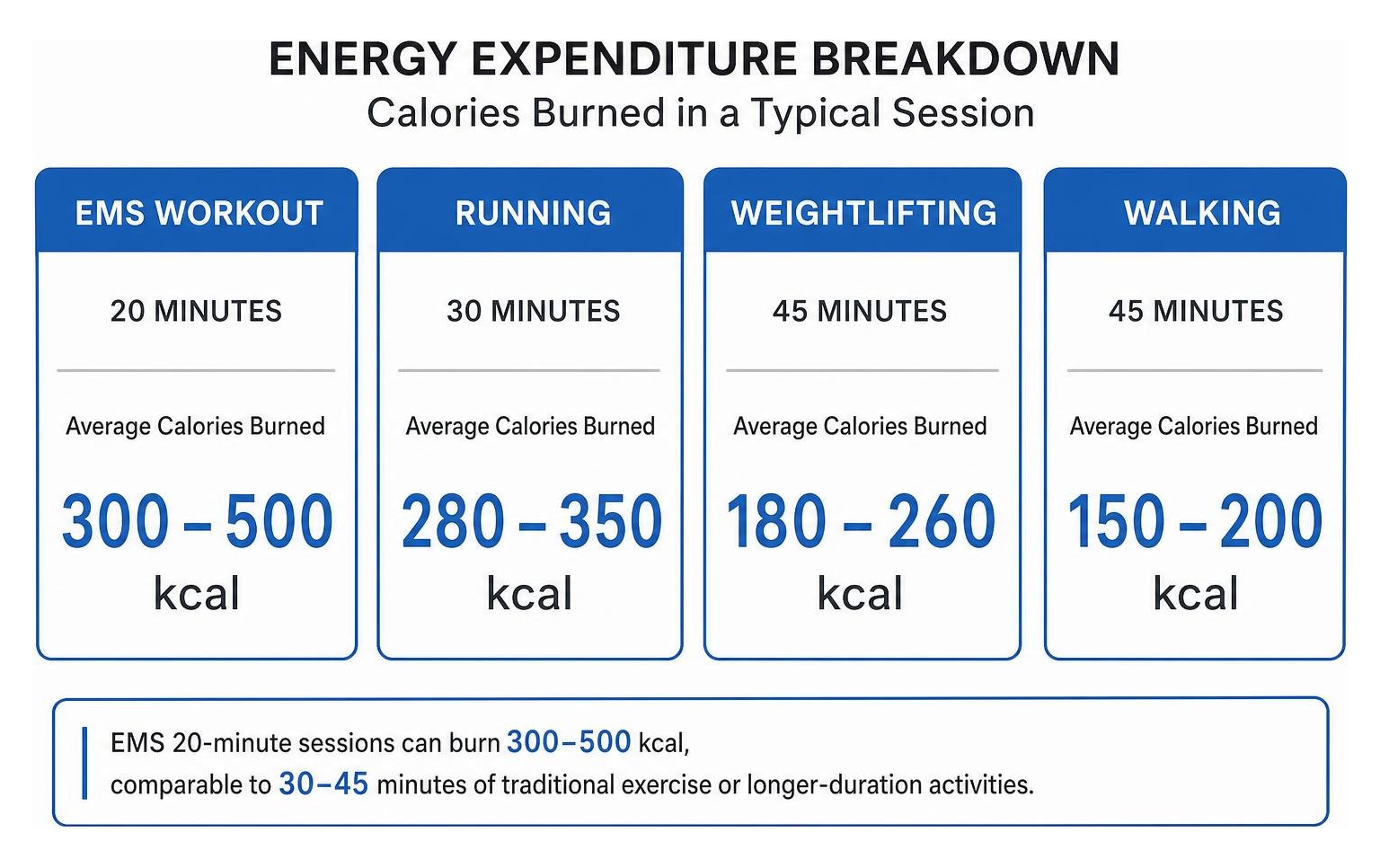
During a structured, 20-minute full-body EMS session where impulses are paired with dynamic isometric or functional exercises (such as squats, lunges, and torso rotations), total caloric expenditure typically ranges between 300 and 500 calories.
Some laboratory studies using high-intensity protocols have recorded participants expending roughly 412 calories in 16 minutes of active stimulation, which equates to over 500 calories over a full 20-minute protocol. That breaks down to an average burn rate of 15 to 25 calories per minute.
To put that into context, achieving a 400-calorie burn in 20 minutes through conventional exercise usually requires high-impact, vigorous-intensity activities like competitive rowing, hill sprints, or running.
The Post-Session Afterburn and EPOC Effect

One of the most frequently misunderstood components of EMS training is the "afterburn effect," formally known as Excess Post-Exercise Oxygen Consumption (EPOC).
Following an intensive EMS session, your body must restore adenosine triphosphate (ATP) stores, clear lactic acid, replenish muscle glycogen, and initiate cellular repair across thousands of deep muscle fibers. Research confirms that during the immediate 10-minute recovery window post-stimulation, energy expenditure remains elevated by approximately 5.00 kcal/hour above resting baseline.
While commercial claims sometimes promise thousands of calories burned for days after a session, the scientific reality is more measured: EPOC provides a modest, helpful post-workout metabolic elevation that contributes to your total daily energy balance, especially when supported by adequate sleep and recovery.
How EMS Compares to Traditional Workouts and Daily Energy Expenditure
To understand how EMS fits into your overall fitness routine, it helps to compare its energy expenditure against traditional gym workouts, outdoor cardio, and everyday tasks.
| Exercise / Activity Type | Typical Duration | Average Calories Burned | Joint Impact Level | Primary Fitness Adaptation |
|---|---|---|---|---|
| Full-Body EMS Session | 20 minutes | 300 – 500 kcal | Very Low | Muscle activation, strength & tone |
| Moderate Running (5 mph) | 30 minutes | 280 – 350 kcal | High | Aerobic endurance |
| Traditional Weightlifting | 45 minutes | 180 – 260 kcal | Moderate to High | Hypertrophy, maximal strength |
| Stationary Cycling (Moderate) | 30 minutes | 210 – 300 kcal | Low | Cardiovascular conditioning |
| Brisk Walking (3.5 mph) | 45 minutes | 150 – 200 kcal | Low | Baseline aerobic health & NEAT |
For assessing metabolic rates across diverse physical duties, researchers and exercise physiologists often rely on MET-based energy expenditure metrics to evaluate how different loads and movement patterns demand oxygen from working muscles.
Key Factors Influencing Calories Burned EMS Workout Results
No two bodies burn fuel at the exact same rate. Several individual variables determine where your session falls on the 300-to-500 calorie spectrum:
- Stimulation Intensity and Motor Threshold: Energy expenditure scales directly with pulse amplitude and depth. Higher tolerable settings recruit deeper muscle fibers, demanding more energy.
- Lean Muscle Mass: Muscle is metabolically active tissue. Clients with higher baseline muscle mass naturally burn more calories during and after muscle contractions.
- Body Composition and Weight: Moving a larger body mass through space requires higher mechanical work and energy output.
- Electrode Contact and Placement: Professional full-body suits (such as our Miha Bodytec systems) ensure targeted stimulation across all major muscle groups simultaneously, maximizing recruitment.
- Voluntary Effort: Engaging actively into each impulse generates significantly higher metabolic demand than remaining passive.
EMS vs NEAT and Cardiovascular Exercise
While dedicated workouts are vital, they represent only a fraction of your total daily energy expenditure (TDEE). A substantial portion of the calories you burn daily comes from Non-Exercise Activity Thermogenesis (NEAT)—the energy expended for everything we do that is not sleeping, eating, or sports-like exercise.
According to research on NEAT calorie burn strategies, simple manual tasks and consistent daily movement (such as walking, cleaning, or taking the stairs) can easily contribute an extra 300 to 500 calories burned daily.
Furthermore, high-stress occupations emphasize physical longevity; the National Association of Emergency Medical Technicians highlights occupational movement and conditioning guidelines that focus on movement quality and joint preservation. Combining the ultra-low-impact, high-intensity recruitment of EMS with consistent daily NEAT provides a powerful, joint-friendly formula for fat loss.
How to Structure an EMS Routine for Sustainable Fat Loss

To transform EMS calorie burn into lasting body composition changes, you need a structured, progressive plan. At EMS Concierge, our certified trainers bring professional-grade Miha Bodytec equipment directly to your living room.
Understanding how in-home EMS training compares to conventional gym workouts helps establish realistic expectations: EMS provides intense, deep neuromuscular recruitment without joint strain, making it an exceptional pillar for body recomposition.
Weekly Scheduling, Progression, and Recovery
Because whole-body EMS stimulates up to 90% of your skeletal muscle fibers simultaneously at high intensity, muscular recovery demands are substantial.
When establishing your routine, booking a structured weekly routine ensures you maintain consistency while respecting physiological rest periods:
- Weeks 1–2 (Acclimatization): 1 session per week at moderate intensity (50–60% output) to build neuromuscular tolerance and prevent excessive delayed onset muscle soreness (DOMS).
- Weeks 3–6 (Building Intensity): 1 to 2 sessions per week, progressing to 65–75% intensity, incorporating dynamic functional movements.
- Week 7 and Beyond (Maintenance & Progression): 2 sessions per week maximum, spaced at least 48 to 72 hours apart to allow complete muscular protein resynthesis and central nervous system recovery.
Nutrition, Protein Intake, and Caloric Deficit
No fitness modality can out-train an uncontrolled diet. To lose one pound of fat per week, you need an energy deficit of roughly 3,500 calories over seven days—or approximately a 500-calorie daily deficit.
To preserve lean tissue while shedding fat during an EMS program:
- Maintain Protein Targets: Consume 1.6 grams of protein per kilogram of body weight (or roughly 0.8–1.0g per pound) daily to support muscle repair.
- Hydrate Strategically: Drink at least 500 ml of water 30 minutes before your EMS session to ensure optimal electrical conductivity through muscle tissue.
- Post-Workout Refueling: Pair high-quality protein with complex carbohydrates within 60 to 90 minutes post-session to replenish glycogen stores and aid recovery.
Safety Standards, Contraindications, and Best Practices
EMS is an exceptionally safe modality when conducted under certified supervision using medical-grade equipment. However, because the electrical impulses bypass central nervous system inhibition to create strong involuntary contractions, strict safety protocols must be followed.
Who Benefits Most from Stimulation Training?
- Busy Professionals: Individuals who struggle to fit 4 to 6 hours of weekly gym visits into their schedules benefit from our mobile 20-minute sessions.
- Postpartum Women: Mothers looking to safely reactivate deep core and pelvic floor muscles without high-impact spinal loading.
- Individuals with Joint or Back Pain: EMS creates zero shear stress on knees, hips, and spinal discs, allowing intense muscular work without joint irritation.
- Sedentary Adults Beginning Fitness: Provides a controlled, supervised reintroduction to strength conditioning.
FDA Guidance and Training Safety Protocols
The FDA regulates EMS devices into clear categories, classifying commercial systems for muscle re-education, increasing local blood circulation, and muscle toning.
Absolute Contraindications Include:
- Cardiac pacemakers or implanted defibrillators
- Pregnancy
- Epilepsy or active seizure disorders
- Acute hernia or open skin lesions in electrode areas
- Severe cardiovascular diseases or unmanaged circulatory disorders
Certified trainers ensure proper pulse parameters (typically 20–85 Hz with a balanced duty cycle such as 4 seconds on, 4 seconds off) to prevent overtraining and ensure maximum comfort and efficacy.
Frequently Asked Questions About EMS Calorie Expenditure
Can an EMS workout completely replace traditional cardio for weight loss?
While EMS is fantastic for calorie expenditure, muscle toning, and metabolic conditioning, it does not fully replicate the steady-state aerobic adaptations provided by cardiovascular exercise (like jogging, cycling, or swimming). For optimal health, we recommend pairing 1–2 weekly EMS sessions with regular daily walking or low-impact cardio.
Does electrical muscle stimulation help spot-reduce abdominal fat?
No. Spot reduction is a physiological myth. EMS strengthens, tones, and tightens the underlying abdominal and core musculature—which can significantly trim waist circumference and improve posture—but fat loss occurs systemically across the entire body through a caloric deficit.
How many times per week should you train with EMS for optimal fat burning?
For most individuals, one to two 20-minute sessions per week is the optimal frequency. Because EMS recruits deep motor units across multiple muscle groups simultaneously, your muscles need 48 to 72 hours of recovery between sessions to repair and grow stronger.
Conclusion
Full-body electro-muscle stimulation provides an exceptionally time-efficient, scientifically proven way to elevate energy expenditure, burn between 300 and 500 calories in just 20 minutes, and build lean muscle without joint strain. When combined with consistent daily movement and a balanced, protein-rich diet, it serves as a powerful catalyst for sustainable fat loss.
At EMS Concierge, we bring certified trainers and state-of-the-art Miha Bodytec technology directly to your home. Experience the efficiency of professional full-body EMS training and discover how a customized 20-minute workout can elevate your wellness routine today.
References
Hsu MJ, Wei SH, Chang YJ. "Effect of neuromuscular electrical muscle stimulation on energy expenditure in healthy adults.." Sensors (Basel, Switzerland), 2011. PMCID PMC3274051.